Showing posts with label Egret. Show all posts

Tuesday, 13 July 2021

Great White Egrets

 I stood in a hide, at the RSPB's splended Ham Wall nature reserve in Somerset, in view of Glastonbury Tor, that small tower sat atop a hill overlooking the Somerset Levels, the marshes of Avalon, alleged stamping ground of King Arthur and his Knights, where Pagan Britons and Christian Anglo-Saxons apocryphally made play for the heart and soul of what we now call England. A mighty bird stood in front of me, just metres away, filling the 75-250mm lens of my camera, all in white, bill turning from black to yellow, fishing, preening with an air of magisterial indifference. The bird stood tall, the shape of a skinny Grey Heron, or an albino woodpigeon with a snake threaded through it, wearing stilts. It stepped forward, creeping, and stared at the water, with the suggestion of intent, before continuing to preen itself.  When noisier people entered the hide, it flew away, low across the water to a new position behind the reeds.


This experience would have been unheard of a few decades ago. First recorded in Britain in the mid 19th Century, though possibly with a history here going back much further, the Great White Egret was a scarce vagrant, less than annual until the 1990s, then annual wintering, I saw my first in 2010, at Dungeness in Kent, where a wintering bird, earning the universal Great White Egret nickname of 'Sharky,' had taken up home in a far flung reedbed. It was little more than a speck in my scope, the size of the bird, its height against the reeds, and its bright yellow bill (which turns black in the breeding season) making it unmistakeable. Great White Egrets are sometimes considered confusable with Little Egrets, but in reality I find them more confusable with a swan, on account of their huge scale in comparison with the more familiar of our two white herons. If you think you might have seen a Great White Egret, you haven't. You have seen a Little Egret. If you see a Great White Egret, you know what you have seen.


My next encounter with the species was in Greece, where I worked as a volunteer for the Hellenic Ornithological Society. A flock of 30 'Sharkies' had dropped into the brackish water marsh, cleared out from their breeding grounds, looking for somewhere to spend the winter. I watched in wonder as they stood stock still in the mirror still water, harbingers of a changing season. Southern and Eastern Europe once held the nearest surviving Great White Egrets. Once common in much of Central Europe, Great White Egrets, like so many charismatic wetland species, were victims of persecution as competitors for fish, and of the millinery trade in the 19th and early 20th century, pushing the centre of their European population East, with birds shot off their nests in the breeding season for their showy breeding plumes, a bold fashion statement for a Victorian lady to wear on her hat. The species has a wide distribution spanning five continents, and many North American colonies of Great Whites faced similar persecution. It was seeing the fate of these birds on their nests which spurred into action the ladies who went on to found both  the RSPB and the Audobon Society, whose campaigns eventually saw the species have something of a repreive, on both sides of the Atlantic.  So it was from Southern and Eastern Europe that the species began to spread.


In 2012, the species bred in the UK for the first time, on the Somerset Levels, at Shapwick Heath, a stones' throw from my Great White Egret experience. In 2017 it bred in Norfolk. Its breeding population continues to grow, and all these breeding attempts have involved small colonies of multiple pairs, on stick nests in trees, not dissimilar to Herons and Little Egrets. In January this year, one flew over my house in Wirksworth, Derbyshire, easily distinguished from a little egret by the sharp bend in its neck, protruding like a keel, and by its vast size and yellow bill like a sword. I have seen them standing in the fields by the Derwent of a morning with the Grey Herons, presumably joining them in munching any small mammals driven from cover by the intense winter cold. Several pairs breed at Shapwick Heath, and it was the most numerous Heron I saw at Ham Wall, and they winter up and down the country, including at Attenborough in Nottinghamshire, where their flights to roost are a popular sideshow to the spectacular winter Starling murmurations.


The Great White Egret is doing well. And I wholeheartedly approve.  Within minutes of its departure, no sooner than the hide was quiet again, my Great White Egret was back, ducks herding their broods away into the reeds with justified concern, and back to preening, nonchalantly, at home in this place of Arthurian legend.


Saturday, 12 October 2013

Wicken Fen

Please excuse the months it has been since I last blogged. A master’s degree can rather suck up ones free time. Which is a shame, as my field work on Warton Crag would have offered a lot to blog about. However, please forgive. 

the historic wind pump at Wicken Fen.


Having got back to the Home County, perhaps a little reluctantly, after my year in the wonderfully wet and windswept North West, I took a ride up to the Cambridgeshire fens with my folks for a day on the 1st October. We went to the National Trust’s Wicken Fen, one of the oldest Nature Reserves in the country. A small visitors centre, a glorified souvenir shop with the typical National Trust merchandise at typical National Trust merchandise greeted us. We stepped outside into the sedge fen, where a boardwalk led us through the tall reeds to a small windmill, or wind pump, a small reminder of the times when the fens were being drained for agriculture, when these once vast wetlands shrank, consigning much of their wildlife and the way of life of their people to history.  They once stretched across a huge swathe of East Anglia, the reed and sedge regularly harvested for building materials maintaining the open reed beds, and the people fishing and hunting wildfowl. Cranes used to nest here, alongside a huge range of bird life through the seasons. Here at Wicken, a fragment survives. The reeds still grow tall, sometimes rising to head height as I walked along the boardwalks among them, and they are still harvested to keep the site open. Patches of Carr woodland, with silvery Sallow and Alder trees still offer a habitat to passerine birds. The site was saved by the National Trust in 1899, when part of the reserve popular with the botany department at Cambridge University, and used by insect collectors was bought by the nascent heritage NGO.  On summer nights the banks of the loads were lit up by the ‘Edison lighthouses’ of numerous moth trappers. The Cambridgeshire fens once hosted Large Copper and Swallowtail butterflies, the former now gone from the UK, and the latter confined to the Norfolk Broads, despite attempts to reintroduce both species over more recent decades.

The Common Darter on our boat trip


We opted to explore the site initially by taking a boat ride on the lodes, the man-made waterways that cross the site and eventually link it to the river Cam. The electric vessel made its way among the reeds, as our informed guide brought our attention to the Guilder Roses, red with fruit, that grew among the reeds. Where the reed beds gave way to meadows, the highland cattle, which are left apparently in a wild state, in their small groups, and the Konik geldings which manage the vegetation with their grazing looked on curiously. A male Common Darter dragonfly was our companion for part of the journey, sunning himself on the plastic floor of the boat until he was interrupted and chased off by a rival conspecific. While there were few birds about, there were plenty of dragonflies, Southern and Migrant hawkers, the males with electric blue bands on their slender abdomens and in their eyes patrolled the reeds, wheras Common and Ruddy darters sat motionless on the reeds, waiting to take off and snatch smaller insects out of the air, or engage in aerial combat to fend off their rivals. A buzzard wheeled effortlessly on the thermals in the blue sky, and a few late Swallows and House Martins were still on the wing, many of them juveniles, surely days away from the perilous trip South.  As if to provide a counterpoint to the wildlife, American AWACS aircraft were flying over occasionally all day. 

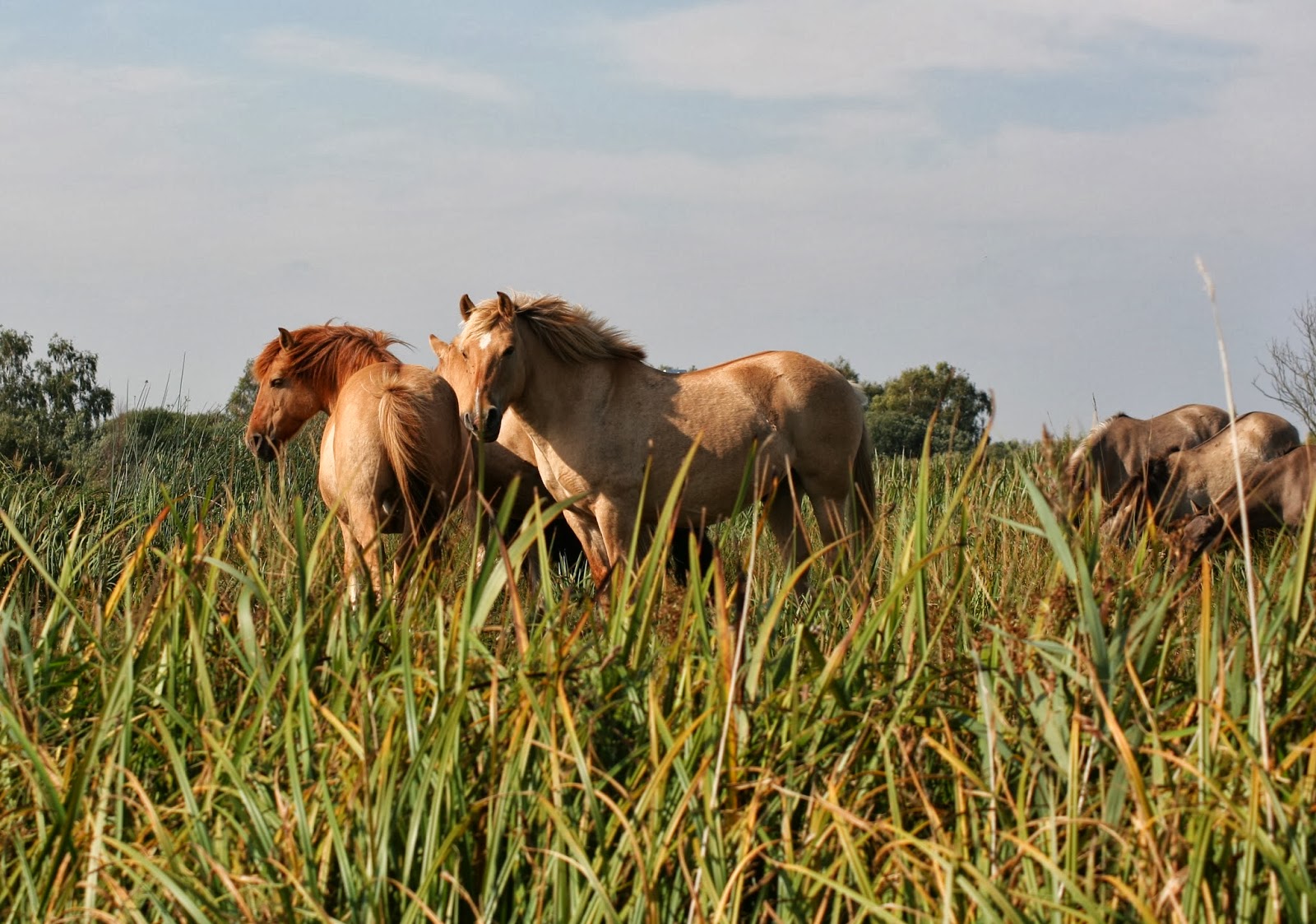
Konik Horses


NATO Boeing 707 AWACS aircraft.


Our boat eventually returned to the visitors centre and we treated ourselves to the inevitable National Trust coffee and cake, before heading back out along the bank of Wicken Lode. A sign at the visitors centre advised us of a couple of scarce birds visible from one of the hides, and a chat with the lady in the centre informed us of their most recent known location. We walked along the short grass beside the load. Roach and sticklebacks shoaled in the crystal clear water, and a Mute Swan hissed at us as we passed. We made in to the hide after an hour’s walk.  It had a view of the open water of ‘the Mere’ as it is known, a small area of still open water fringed by the ubiquitous Phragmites reeds and Carex sedges. Four Cormorants (Phalacocorax carbo) sat on a log that stuck out of the water, and a number of Mallard and Teal dabbled in the shallows in front of us. out across the water was the bird we were looking for. With a Grey Heron (Ardea cinerea) stood beside it, if only to demonstrate the size of the bird, was a Great White Egret (Ardea alba). This is a tall, long-necked and stunning looking heron that is somewhat rare in the UK. Indeed the first breeding pairs in Britain in recorded history bred on the Somerset Levels in 2012.   It stands taller than a Grey Heron, to which it is closely related, and its plumage is bright white, like that of the much smaller Little Egret which colonised the UK in the 1990s.  And here one was, preening itself nonchalently. 

The Great White Egret

I looked through the scope and scanned the bases of the reeds. There was another snipe opposite us, close to the egret, and a couple of smart Godwits, medium-sized waders with very long beaks, wading about and probing in the lake mud. But something at the bottom of the reeds caught my eye. Stripes. Golden stripes, against a dark coloured back, a bird hunkered down among the Phragmites. I wasn’t sure, but I showed the other birders and family members present. We figured it was a Jack Snipe. Seconds later it stood up, and wandered around with the characteristic bobbing motion associated with that species. Two rarities! A couple of smaller waders, periodically flying low across the water as they moved between feeding spots, turned out to be Dunlin, and the ducks were joined by a small party of scruffy looking Shoveller, ducks with massive bills, which arrived with an influx of Teal and Mallards.  We stayed and watched the birds, as the Jack Snipe faded once again into the reeds and his excellent camouflage.

We left the hide not long after the Egret took to the wing and flew off on slow lazy wing beats over the tops of the reeds, assuming the strange, front heavy shape of a heron in flight. we wandered back through the reeds, before setting out, just as the sun was beginning to drop nearer the long, flat fen land horizon. We found a small hide, just a couple of hundred metres from the visitors centre where we could watch a couple of Marsh Harriers, large, scarce birds of prey but increasingly familiar on the wetlands of South Eastern England, hunting over the reeds, wings raised up slightly, riding on the evening thermals. Every so often a coot or moorhen would be flushed from the reeds. These big birds of prey were splended but what happened next was something of a surprise. We wandered out of the hide and onto the board walk, which would take us on a short circuit around the area known as Sedge Fen. I saw ahead of us what looked like another Marsh harrier, sharing the same  profile in flight, so I raised my binoculars to look at it. This bird was moving faster than a Marsh Harrier, and when it stooped after something in the reeds, it moved quicker than any marsh harrier I had seen. Its’ wing tips were black, and its back a very uniform steely grey, apart from a white flash above its tail.  I wasn’t looking at a Marsh Harrier. I was looking at an adult male Hen Harrier, one of the most threatened and rarest breeding birds in Britain. This one wasn't breeding here, the UK population breed in the uplands and fly down to the coast in winter. He was probably passing through to a wintering ground further South; those that winter at Wicken Fen I learned from the informed volunteer at the visitors centre later do not typically arrive until later in the year.

A hen harrier. I had just returned from a year spent beside the Forest of Bowland, last breeding site of Hen Harriers in Britain, without ever seeing one, and here I was in Cambridgeshire, looking at such a beautiful, elegant adult male.

A successful days birding, I thought.


Sunday, 17 February 2013

RSPB Leighton Moss 17th February 2013


On a day that was truly beginning to feel like spring I took myself up to my favourite wetland in the whole of North Lancashire, the RSPB’s Leighton Moss, which sits in a valley close to Morecambe Bay, in the shadow of Warton Crag, in the Silverdale AONB.  I took with me the excuse of going to look for literature, I am set to do my dissertation project up on Warton Crag, looking at butterflies in the summer.  Before I reached the car park I wondered if there was a big twitch on, such were the numbers of people lugging their scopes up the road. It turned out the only particular rarity in the sky above Leighton Moss was the sun. It had brought the people out on a sunny Sunday afternoon for sure. Although I had arrived alone this would not be a day of birding with solitude, and the reserve hosted quite a volume of people!  The sound of distant shooting also broke my tranquillity a little bit, although my inner hippy was calmed a little when a volunteer reassured me today’s shoot was for Clay Pigeons.


I paused initially at the Moss Passerine Experience, or feeding station as its more popularly known, and watched the handsome Chaffinches, looking very bright and sharply coloured in the sunshine. There was a Brambling about, a close relative of the chaffinch and relatively scarce winter visitor.  Numbers vary from winter to winter, but they are about every year, apparently displaying very little site fidelity, and they are irruptive.  When in small numbers they tend to follow flocks of chaffinches, and this, a smart female with resplendent orange shoulder flashes, was doing just that. She would appear on one of the bird feeders for a couple of seconds before being off in a blur of black, orange and white. Bramblings always have distinctive bright white rumps, which are usually a dull green in Chaffinches.


Also around the feeders were the obligatory pair of bullfinches, the male with his bright, unmistakeable pink breast, perched openly, even allowing for a couple of blurry photographs in one of the trees. The female is just as pretty but a little more subdued in markings. Bullfinches are shy birds and feeding stations like this present an unusual opportunity to get close to them. A feeder with several ports at which the birds could land on it was squabbled over by chaffinches, but the Brambling appeared able to chase them off, and among the assembled spectators getting photos of unusual combinations of passerines on this feeder  became a pastime.  Goldfinch, Robin and Dunnock were also to be seen on the feeders.


I wandered down to the public hide, in the hope of catching up with an Otter or a Bittern, both of which have been seen there, the former apparently this morning according to a lady with a posh scope.  I saw neither, but there were a couple of smart Greater Black Backed Gulls munching on a tasty looking chunk of Perch they’d managed to get their claws into. A few cormorants shared a shingle island with them, and the telescope (hooray I got my new toy back!) picked out some roosting Lapwing behind them. I moved on to the lower hide, from which one of the Marsh Harriers, an old female, could be seen quartering over the reeds. The coots were chasing each other about, and I scanned the distant flocks of Tufted Duck for Scaup, fruitlessly, although there was a female Pochard in amongst them. A pair of Great Crested Grebes bobbed and nodded elegantly at each other. I’ve only seen the famously romantic weed pass in which Grebes indulge once, and was hoping that this amorous duo might perform for the camera, but watching their elegant bobbing and mirroring display was beauty enough. On my return stroll through the reindeer-lichen and Jew’s ear bedecked trees,  I once again made the acquaintance of the friendly, and particularly gorgeous, cock Pheasant who hangs out up there.  He posed for a couple of photos before weight of human traffic on the little causeway, and an alarming pheasant out on the shooting estate next door, sent him scurrying for the shelter of the enormous reed beds.

Freindly Pheasant


Spring was again in the air as robins could be seen doing the tail cocking and chasing but not with real intent thing, indicating breeding birds sussing each other out for mate potential despite their still strong and fiercely territorial instincts.

Once back at the visitors centre I grabbed a cup of coffee, and chatted to one of the staff about the butterflies of Warton Crag. Bring on the summer, there are Scotch Argus and High Brown Fritillary in addition to the lovely little Northern Brown Argus, which I hope to help a little through the application of science this summer, to be seen! Butterflies over coffee aside, I made my way to the Tim Jackson hide, which lies at the Western end of the main reserve. I noticed a Marsh Tit on a branch as I walked through the woods. To my surprise another perched a few feet from it. The first bird darted down and into a small gap in a moss covered log, and appeared to retrieve something. It’s partner then did the same, until a chaffinch chased it away. The chaffinch was chased off by a Dunnock, which retreated when a Nuthatch arrived. The penny soon dropped that someone had placed some sunflower seeds inside the log, and it was on these that these disparate passerines were feeding. The Marsh tits returned breifly until the prettiest blue tits ever chased them off, feisty little birds that they are.  I watched for a few minutes and, even in the dim light of the woods, managed to rattle off a few photos of the passerines as they came and went, usually pursuing each other as they did so. 


Marsh Tit


The Tim Jackson hide revealed a Little Egret and another quartering Marsh Harrier, and the usual selection of ducks.  The low sun through the window made birding tricky and I decided to use the last hour of fading light to check out the pools on the salt marsh from the Eric Morecambe hide. The car park bears dire warnings of car thieves, but I parked up and wandered on anyway. The sun was setting over the flat expanse of salt marsh down to the edge of Morecambe Bay. Another Egret could be seen standing about beside the reeds, and there were numerous handsome pintail about on the water. A Marsh Harrier scattered them, but as the birds settled back in, there was a pair of Avocets among them. These beautiful black and white waders apparently breed here, beside the expansive bay. As the sun dropped below the horizon, lighting up a red sky streaked with cirrus clouds and air trails, I was struggling to separate waders in the settling gloom, but the little cluster still active consisted of two Redshank, two Spotted Redshank and a Greenshank.

I walked back slowly toward the car, with my scope slung over my shoulder. I became aware of a shape, stock still against the horizon, on top of the ridge. It was a deer. I hadn’t seen one here since my and Natalie’s encounter with one at the Moss some time ago. The animal was picked out against the red sky, and it stood stock still, presumably hoping in stillness lay invisibility. It lifted its head and shook its ears. 


Full Species List for 17/02/2013


Mute Swan Cygnus Olor, Whooper Swan Cygnus cygnus, Canada Goose Branta Canadensis, Greylag Goose Anser anser, Mallard Anas Platyrynchos, Teal Anas creccia, Wigeon Anas penelope, Shoveller Anas clypeata, Pintail Anas acuta, Gadwall Anas strepera, Tufted Duck Aythya fuligula, Pochard Aythya ferina, Goldeneye Bucephala clangula, Shelduck Tadorna tadorna, Coot Fulica atra, Moorhen Gallinula chloropus Pheasant Phasianus colchicus, Snipe Gallinago gallinago, Avocet Recurvirostra avocetta, Greenshank Tringa nebularia, Redshank Tringa totanus, Spotted Redshank Tringa erythropus, Black Tailed Godwit Limosa limosa, Curlew Numenius arquata, Lapwing Vanellus vanellus, Little Egret Egretta garzetta, Cormorant Phalacrocorax carbo, Great Black Backed Gull Larus marinus, Black Headed Gull Chroicocephalus ridibundus, Marsh Harrier (Circus aeruginosus) Woodpigeon Columba palumbens, Carrion Crow Corvus corone, Jackdaw corvus monedula, Magpie pica pica Starling (Sturnus vulgaris) Blackbird (Turdus philomelos) Redwing (Turdus illiacus) Robin (Erithacus rubecula) Dunnock (Prunella modularis) Nuthatch Sitta Europea, Blue tit (Cyanistes caeruleus) Coal tit (Paraparus ater) Marsh Tit (Poecile palustris) Great tit (Parus major) Brambling  Fringilla montefringilla, Chaffinch Fringilla coelebs, Bullfinch Pyrrhula pyrrhula, Goldfinch Carduelis carduelis, Greenfinch Carduelis chloris,

Thursday, 27 September 2012

Leighton Moss


Looking at the grey sky, I am afraid I failed to rise with the lark this morning and get to the RSPB’s reserve at Leighton Moss as the Sun came up, but I did make my way to my new local big RSPB reserve this afternoon.  I arrived under the bluest sky I have seen since I arrived in the North West. The leaves on the trees up here have already started turning, leaving me feeling like I had lost a couple of weeks off the end of Summer somewhere on the M6, and despite some sunshine yesterday, it has rained continuously since the day after I arrived, albeit with rainbows.

The downpours which have afflicted the North of England in recent weeks will not have gone unnoticed given all the flood warnings. Here in Lancaster I am fine, it has rained incessantly bar two days since my arrival but when I reached Leighton Moss I was a little disappointed to find that I was only able to view half of the reserve as some of the paths had become flooded. I left the visitors centre and took the opportunity to glance at the feeding station which sits outside it. There was a large amount of Passerine activity, with chaffinches and greenfinches alongside a less familiar Marsh Tit and a number of scruffy juvenile Bullfinches. One young male Bullfinch appeared to be gaining his distinctive and instantly recognisable salmon-pink breast in awkward patches. Badger-striped coal tits were here in number, and Mallards, these ones now well past their ‘eclipse’ and regaining their adult plumage, pottered about on the ground picking up the dropped seed from the feeders.
Coal Tit at the Feeding Station.


Scruffy young bullfinch, a stark contrast with the very smart adults.


After a few attempts to photograph some of the passerines, a task made all the more difficult by the positioning of the feeders under a thick woodland canopy, I headed on to the first hide,  called Lillian’s Hide, and from it, a large structure with a wide bay window affording good views across the lake, and was able to get a feel for the reserve. I was there with few expectations, and had been expecting to find a “moss,” that is, a Sphagnum bog, of the type so threatened by peat extraction, and was surprised to find a lowland wetland of much more familiar character.  Leighton Moss is described as the largest reed bed in the North West, and is a combination of Phragmites reed-swamp with scattered clumps of Typha, with its thick dark seed heads, popularly called Bullrush, and open water, fringed by (very) wet woodland, with wooded hill slopes climbing away. It lies in or close to the Silverdale Area of Outstanding Natural Beauty, and the elegantly curvaceous landscape is certainly beautiful. I was surprised to see, given the autumnal character of the last few days, that there were still dragonflies on the wing. Migrant Hawkers patrolled above the reeds. Some of the people in the hide were discussing Otters which had apparently been seen the same morning. Maybe I shouldn’t have been so persistent with that snooze button.   Outside were no more than the usual suspects-coots, some scruffy Tufted Ducks, the males now moulting out of their eclipse plumage, brown and patchy with white flanks, a moorhen or two, and the obligatory mallards. I stayed to enjoy the landscape for a bit, and watch a late Red Admiral butterfly fluttering about,  but the lack of interesting birds drove me on.
RSPB Leighton Moss.


I walked along the path toward the next hide, called the Public Hide, presumably because it sits on a public footpath to Leighton Hall, passing on the way a patch of open grass and a view of the reserve. The reed swamp certainly looked expansive. I continued through a Carr woodland rich in bird calls, and Goldcrests, to the main path through the reedbeds to the hide. I found myself wading uncomfortably through water several centimetres deep, and very cold, but stuck to the path and persevered.   A sign advertised grit trays supposedly frequented by the UK’s most Northerly population of Bearded Tits, but none of these charismatic denizens of thick reed beds were out today. Another advertised Bitterns, but only a beautiful family of mute swans, dabbling about in the sunshine, were to be seen in the patch of open water I looked out upon. Above me a buzzard circled. I might have missed it but for the friendly couple with pleasant local accents who pointed it out, along with the distinct absence of bearded tits, which they suggested might be in Africa. I replied that they might equally be at Purfleet. No bearded tits, but I took a moment to enjoy the sight of a large bird of prey circling on thermals above the beautiful Lancashire countryside.
Mute Swans near the Public Hide.


The view from the public hide was not much better than the first, again with Mute Swans, Mallards, Coots and Tufties. Not fancying further wading along the flooded paths, it was with a sense of mild disappointment that I made the return trudge through the freezing water.  As I re-entered the Carr woodland I was in for a pleasant surprise. A flock of small birds was moving though, paying particular attention to one Elder bush. This was one of the big gangs of mixed passerines foraging together and taking advantage of safety in numbers through the Autumn and Winter.  They are said to tolerate each other for this reason-while each species has a subtly different diet to the others. Goldcrests foraged frenetically among the yellowing leaves, and long tailed tits contact-called to each other. Blue tits and coal tits hung upside down from the tips of branches, and Treecreepers wound their way up the stems.  Great tits paused before disappearing into the depths of the vegetation, and smart Chaffinches and Greenfinches perched boldly and openly on the lower branches.   As I stood enjoying the spectacle of all these birds around me, yet more species piled in. A very handsome, boldly striped male Siskin appeared before disappearing among the elders’ leaves. A bird I enthusiastically called as a Garden Warbler turned out to be a female Blackcap.  I am certain I have never seen a fraction of this number of goldcrests in one place before, even in sheltered southern woodlands on snowy days.  A Marsh tit was also briefly visible. An older couple also stood enjoying what the RSPB might describe as a “moment,” and they told me they had seen a Willow Warbler in the flock as well.  We were surrounded by tiny passerines. In all the flock seemed to contain no less than 11 species, including the ten I had seen and the friendly couple’s Willow Warbler.  A Robin appeared and made angry noises toward the other passerines, and as soon as the show had begun, it was over, the distinct shapes of two Long-tailed Tits were briefly silhouetted against the sky through a gap in the branches appeared as stragglers, as the flock moved on to new bushes deeper in the woods and further from the path.  I don’t know whether the chirpy but highly territorial Robin had actually chased the whole flock away, but he seemed content to have his bush to himself again.

Very nervous coot.


I continued my return journey to Lillian’s hide.  There were a few Siskins feeding on the Birch which hangs over the hide. Inside the view was a little more interesting than before, and I hung on for a while in the hope of seeing some otter action. None was forthcoming, but a handsome, and very well camouflaged Snipe offered a rare photo opportunity, as it probed about in the  mud where some of the reeds had been cut, in search of invertebrate prey.  A very handsome Grey Heron stood silently and solemnly on one of the islands, eventually tucking his head away under one wing and roosting there. A single Little Egret flew over. I was surprised to see the small white heron so far north just a few decades after its rapid invasion of the country, I thought of them as a Southern thing.  A Gadwall, a male smart in his fresh breeding plumage, swam by, allowing me to add another water fowl to my list. As I enjoyed the view, I saw a number of Mallards take off in the back of my view. The coots instantly fell silent. One moment ago they had been splashing about, calling, bickering with each other, and diving for weeds. Now they swam quickly, some of them running on the water, onto the island, where they stood tensely among the reeds staring fixedly across the water. I followed their gaze. A Marsh Harrier was quartering over distant reeds, wings raised in a shallow V, with gold around her face and the leading edges of her wings. She settled into a bush across the water, where she remained as long as I did. I waited a while, fruitlessly, in the hope of meeting my first English otter, and eventually the tension among the coots subsided and some of the bolder ones ventured back into the water, still clearly aware of the deadly predator on the other side of the water. 

Very handsome and obliging Snipe.


I took a walk back to the RSPB visitors centre for a swift cup of coffee, and then took another look at the feeders.  I could hear the low, throaty bellowing of Red Deer stags in the distance, an enthralling and unfamiliar sound to this Southerner.  A handsome cock Pheasant strutted up and down beneath them. A brown passerine on one of the feeders was revealed to be a Redpoll, another less familiar species. Its body was brown and heavily streaked, with a small red cap on its forehead.   Passerine numbers were down on this morning, perhaps the fading light, and failing weather, it had begun spitting again, had seen some of them off to roost. I watched the antics of some of the remaining birds for a while, there was still a Marsh tit about, before I decided to jump in the car and try to reach the other end of the reserve. The RSPB land straddles a railway line, and to reach the other side I had to drive up in the direction of Silverdale and over a level crossing, then take a right turn after crossing a bridge. Inevitably, I got completely lost and spent several minutes trying to find the place. When I did, and I never got as far as the two Salt marsh hides, which overlook the edges of Morecambe Bay, I discovered Leighton Moss had one more trick up its sleeve to really impress me.
Pheasant at the feeding station.
I drove up the gravel track, having found it eventually, and stopped behind another driver who was looking up at the starlings, which had gathered in some number on the telephone wires which hung between two poles each side of the road, framing a small railway bridge and the sunset behind them. Every couple of minutes a small group of Starlings would arrive from somewhere and jostle for position with the birds which had already arrived. The gentleman in the other car passed me and remarked he was off to get his camera, the starlings had arrived. He departed down the road. Not long after he left, a larger flock appeared, and, as if at a signal, they combined with the flock on the wires and ascended into the sky. At first a disorganised mass of birds, a shape moving low over the reeds appeared to cause them to transform. All at once the edges of the flock became sharply defined, each bird apparently moving as part of some combined whole. They moved quickly, sharply, and as one dived into the reeds. A few moments later the chattering started, and the dark shape rose up and away headed for the hills. It was a fat dark shape, a ball of muscle, a clenched fist of a bird, between pointed wings. I recorded it as a male Peregrine, as it slipped out of site. I waited a few moments listening to the chattering in the reeds. A few pied wagtails flew low over the tops of the reeds as Cormorants passed inland over my head, and a fine rain began to fall as the light continued to fade, the sunset burning a deep yellow-orange, a gap in the cloud fringing the horizon. Lapwings flew down off the slopes, perhaps from further inland, in a flock, toward some protected saltmarsh roosting site. The gentleman with the other car returned with his camera, and was a little disappointed to find himself with only a noisy reed bed to point it at.  A distance away a Marsh Harrier put up small flocks of starlings, rising out of the reeds like puffs of smoke. We both looked at it through the binoculars and enjoyed the presence of a splendid raptor.   The next predator to appear, the starlings saw before we did. First, the noisy chattering of the birds stopped, and then, with a roar like the ocean, like waves breaking on a shingle beach, the starlings in the reeds took flight. The murmuration twisted, a single dark shape composed of what must be hundreds of birds, above the reed bed. Assigning a number of birds to them would have been impossible.  The predator, a juvenile Sparrowhawk which only briefly passed through our field of view, continued on its way and must have cleared the area quite quickly, as the starlings dived down into the reeds in a single column. They fell silent but the sound of the birds’ wings in unison was probably the most memorable feature of the spectacle.  Eventually the chattering resumed, and we watched the sky fill not with dense flocks of starlings but a more diffuse flock of hirundines, shortly, surely, to be on their way back to Africa in pursuit of bugs and summer.  Loosing the light, I headed home, with the word "murmuration" and the sound of hundreds of starling wings in my ears.
Murmuration.