Please excuse the months it has been since I last blogged. A
master’s degree can rather suck up ones free time. Which is a shame, as my
field work on Warton Crag would have offered a lot to blog about. However,
please forgive.
 |
| the historic wind pump at Wicken Fen. |
Having got back to the Home County, perhaps a little reluctantly, after my year in the wonderfully wet and windswept North West, I took a ride up to the Cambridgeshire fens with my folks for a day on the 1st October. We went to the National Trust’s Wicken Fen, one of the oldest Nature Reserves in the country. A small visitors centre, a glorified souvenir shop with the typical National Trust merchandise at typical National Trust merchandise greeted us. We stepped outside into the sedge fen, where a boardwalk led us through the tall reeds to a small windmill, or wind pump, a small reminder of the times when the fens were being drained for agriculture, when these once vast wetlands shrank, consigning much of their wildlife and the way of life of their people to history. They once stretched across a huge swathe of East Anglia, the reed and sedge regularly harvested for building materials maintaining the open reed beds, and the people fishing and hunting wildfowl. Cranes used to nest here, alongside a huge range of bird life through the seasons. Here at Wicken, a fragment survives. The reeds still grow tall, sometimes rising to head height as I walked along the boardwalks among them, and they are still harvested to keep the site open. Patches of Carr woodland, with silvery Sallow and Alder trees still offer a habitat to passerine birds. The site was saved by the National Trust in 1899, when part of the reserve popular with the botany department at Cambridge University, and used by insect collectors was bought by the nascent heritage NGO. On summer nights the banks of the loads were lit up by the ‘Edison lighthouses’ of numerous moth trappers. The Cambridgeshire fens once hosted Large Copper and Swallowtail butterflies, the former now gone from the UK, and the latter confined to the Norfolk Broads, despite attempts to reintroduce both species over more recent decades.
 |
| The Common Darter on our boat trip |
We opted to explore the site initially by taking a boat ride on the lodes, the man-made waterways that cross the site and eventually link it to the river Cam. The electric vessel made its way among the reeds, as our informed guide brought our attention to the Guilder Roses, red with fruit, that grew among the reeds. Where the reed beds gave way to meadows, the highland cattle, which are left apparently in a wild state, in their small groups, and the Konik geldings which manage the vegetation with their grazing looked on curiously. A male Common Darter dragonfly was our companion for part of the journey, sunning himself on the plastic floor of the boat until he was interrupted and chased off by a rival conspecific. While there were few birds about, there were plenty of dragonflies, Southern and Migrant hawkers, the males with electric blue bands on their slender abdomens and in their eyes patrolled the reeds, wheras Common and Ruddy darters sat motionless on the reeds, waiting to take off and snatch smaller insects out of the air, or engage in aerial combat to fend off their rivals. A buzzard wheeled effortlessly on the thermals in the blue sky, and a few late Swallows and House Martins were still on the wing, many of them juveniles, surely days away from the perilous trip South. As if to provide a counterpoint to the wildlife, American AWACS aircraft were flying over occasionally all day.
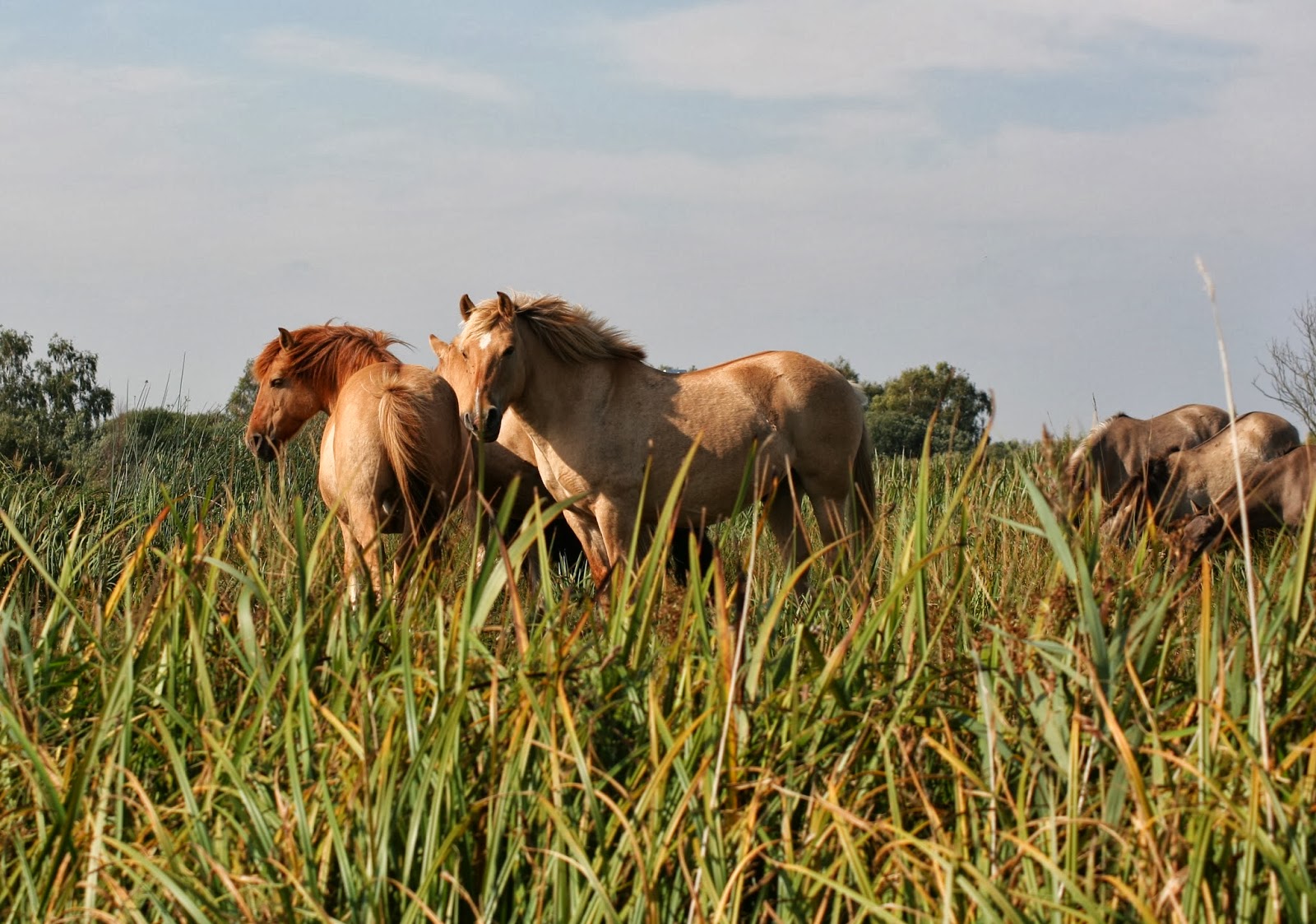 |
| Konik Horses |
 |
| NATO Boeing 707 AWACS aircraft. |
Our boat eventually returned to the visitors centre and we
treated ourselves to the inevitable National Trust coffee and cake, before
heading back out along the bank of Wicken Lode. A sign at the visitors centre
advised us of a couple of scarce birds visible from one of the hides, and a
chat with the lady in the centre informed us of their most recent known
location. We walked along the short grass beside the load. Roach and
sticklebacks shoaled in the crystal clear water, and a Mute Swan hissed at us
as we passed. We made in to the hide after an hour’s walk. It had a view of the open water of ‘the Mere’
as it is known, a small area of still open water fringed by the ubiquitous Phragmites reeds and Carex sedges. Four Cormorants (Phalacocorax carbo) sat on a log that
stuck out of the water, and a number of Mallard and Teal dabbled in the
shallows in front of us. out across the water was the bird we were looking for.
With a Grey Heron (Ardea cinerea)
stood beside it, if only to demonstrate the size of the bird, was a Great White
Egret (Ardea alba). This is a tall,
long-necked and stunning looking heron that is somewhat rare in the UK. Indeed
the first breeding pairs in Britain in recorded history bred on the Somerset
Levels in 2012. It stands taller than a
Grey Heron, to which it is closely related, and its plumage is bright white,
like that of the much smaller Little Egret which colonised the UK in the 1990s.
And here one was, preening itself
nonchalently.
 |
| The Great White Egret |
I looked through the scope and scanned the bases of the reeds. There was another snipe opposite us, close to the egret, and a couple of smart Godwits, medium-sized waders with very long beaks, wading about and probing in the lake mud. But something at the bottom of the reeds caught my eye. Stripes. Golden stripes, against a dark coloured back, a bird hunkered down among the Phragmites. I wasn’t sure, but I showed the other birders and family members present. We figured it was a Jack Snipe. Seconds later it stood up, and wandered around with the characteristic bobbing motion associated with that species. Two rarities! A couple of smaller waders, periodically flying low across the water as they moved between feeding spots, turned out to be Dunlin, and the ducks were joined by a small party of scruffy looking Shoveller, ducks with massive bills, which arrived with an influx of Teal and Mallards. We stayed and watched the birds, as the Jack Snipe faded once again into the reeds and his excellent camouflage.
We left the hide not long after the Egret took to the wing and flew off on slow lazy wing beats over the tops of the reeds, assuming the strange, front heavy shape of a heron in flight. we wandered back through the reeds, before setting out, just as the sun was beginning to drop nearer the long, flat fen land horizon. We found a small hide, just a couple of hundred metres from the visitors centre where we could watch a couple of Marsh Harriers, large, scarce birds of prey but increasingly familiar on the wetlands of South Eastern England, hunting over the reeds, wings raised up slightly, riding on the evening thermals. Every so often a coot or moorhen would be flushed from the reeds. These big birds of prey were splended but what happened next was something of a surprise. We wandered out of the hide and onto the board walk, which would take us on a short circuit around the area known as Sedge Fen. I saw ahead of us what looked like another Marsh harrier, sharing the same profile in flight, so I raised my binoculars to look at it. This bird was moving faster than a Marsh Harrier, and when it stooped after something in the reeds, it moved quicker than any marsh harrier I had seen. Its’ wing tips were black, and its back a very uniform steely grey, apart from a white flash above its tail. I wasn’t looking at a Marsh Harrier. I was looking at an adult male Hen Harrier, one of the most threatened and rarest breeding birds in Britain. This one wasn't breeding here, the UK population breed in the uplands and fly down to the coast in winter. He was probably passing through to a wintering ground further South; those that winter at Wicken Fen I learned from the informed volunteer at the visitors centre later do not typically arrive until later in the year.
A hen harrier. I had just returned from a year spent beside the Forest of Bowland, last breeding site of Hen Harriers in Britain, without ever seeing one, and here I was in Cambridgeshire, looking at such a beautiful, elegant adult male.
A successful days birding, I thought.
A successful days birding, I thought.


