Showing posts with label Fledgelings. Show all posts

Sunday, 15 November 2020

Lockdown Walks, a Retrospective. 21st-25th May.

 21st May 2020

Feeling a touch of sunstroke from my long walk in the heat the previous day, something like the mother of all hangovers, I remained at home today, and enjoyed seeing a Cinnabar Moth in the back garden, a smart, day flying red and black creature. Their larvae, black and yellow striped creatures, feed on Ragwort, and can be seen through the summer months. A Large White butterfly had laid some eggs on my Brussels Sprouts, and I will aim to be the best custodian of them I can be. 

1430-1530

Natty and I visited her bee transects up at the National Stone Centre, a patch of greenery cut by examples of the dry stone waller's craft, surrounding Britain's only museum dedicated to building stone. The sun was hot and high and the Comfrey was in bloom. 

There were some butterflies on the wing including some lycaenids, Common Blues, and a bright orange Small Copper, on a patch of grass beside the Stone Centre car park, my first of the year. A larger Satyrid butterfly which flew by may have been a Wall.


Small Copper Butterfly. 


Bees: Early Bumblebee (worker) Garden Bumblebee (Worker, queen) Buff/White tailed bumblebee (workers) Common Carder Bee (workers) Honeybee (workers) 

Butterflies: Orange Tip (2) Common Blue (2) Small Copper (1)

Birds: Swift, Blue Tit, Great Tit, Chiffchaff, Blackcap, Whitethroat, Blackbird, Goldfinch. 

Gang Mine. 

The mountain Pansies, and tiny white flowers were in bloom on the lead spoil. There were surprisingly few bees, but a beautiful pheasant was standing on the path, confidingly, and hirundines darted about. 

Birds: Pheasant, Black Headed Gull, Woodpigeon, Kestrel, Magpie, Carrion Crow, Blue Tit, Sand Martin, Swallow, Long-Tailed Tit, Chiffchaff, Whitethroat, Blackbird, Mistle Thrush, Robin, House Sparrow, Dunnock, Pied Wagtail.
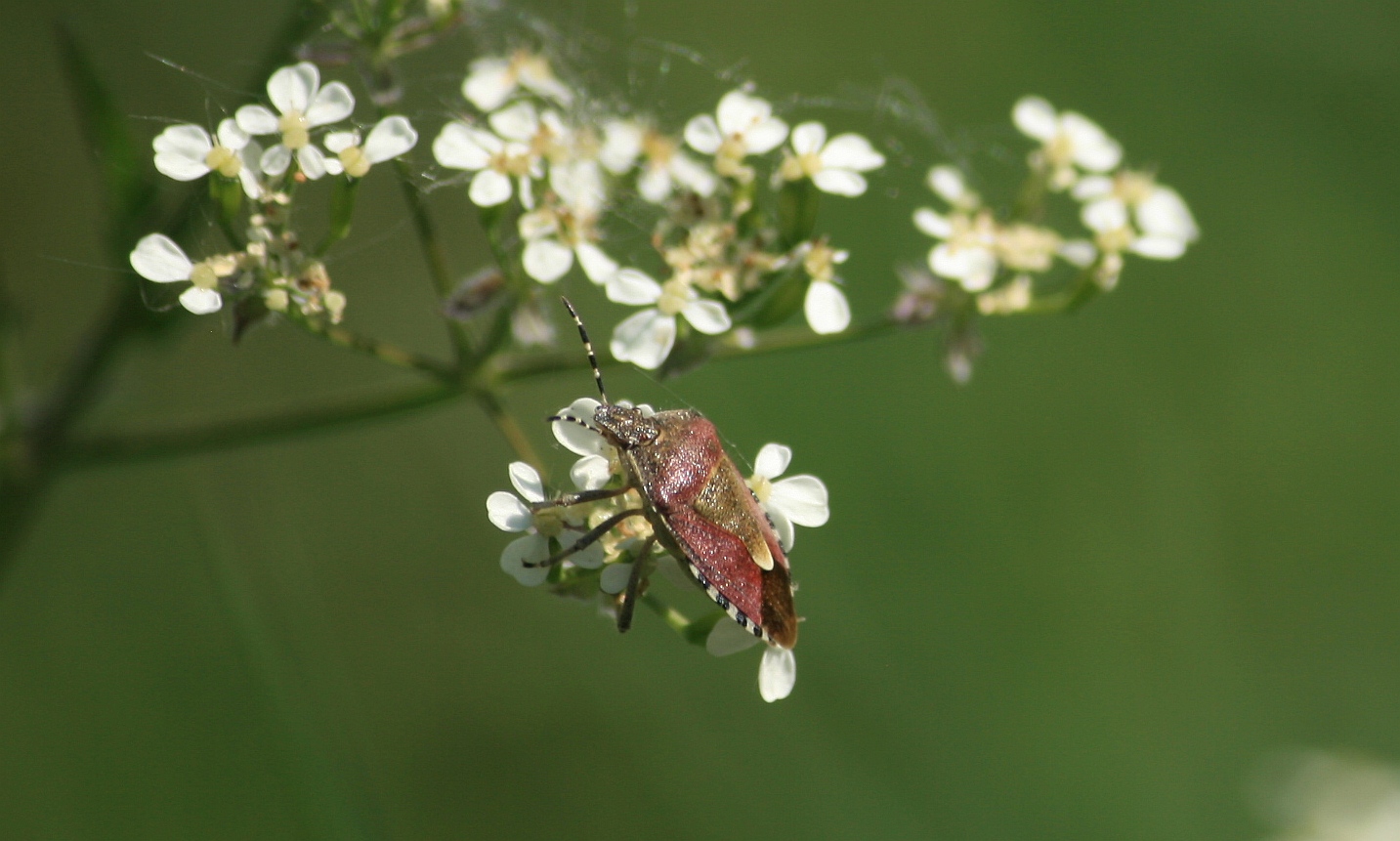

Sheildbug at Gang Mine

Small Heath Butterfly at Gang Mine. 


Butterflies: Small Heath (5) Orange Tip (1) Dingy Skipper (1) Green Veined White (1) Small Copper (1) 

Mammals: Rabbit, Grey Squirrel. 

24th May 2020

Bolehill Envrions

Natalie, Lizzie and I took a wader down to Cromford Canal from Wirksworth, taking the steep ascent to Bolehill. There were plenty of hirundines as swifts cavorting in the blue blazing sky. We took the farm track by the toad pond, so alive a few weeks ago but now near bone dry, and avoided four noisy dogs on the footpath, which yapped in a mildly confrontational manner. 
The Gorses in the cattle field were unusually quiet, but there was a fledgeling Meadow Pipit, my first fledgeling of this species this year. A flock of Goldfinch was busy on the farm track but included no juveniles; I would be interested to know if this collective feeding behaviour is common in the breeding season, or whether these birds were all failed or late breeders. When we reached the canal we found visitor numbers slightly up, but the only canal birds we saw were a single drake Mallard and a flyover Grey Wagtail. 
The climb up the Cromford incline was shallow but seemed unending. The precipitous gritstone cliffs were beautifully bathed in shimmering sunshine. In a small pond some Goldfish seemed to have been dumped, but alongside them some tadpoles persisted and Smooth Newts displayed courtship behaviour, the females gently pursued by the crested and amorous males.  Blue Tits nested in a hole in a concrete gatepost. 
I parted company with Natty and Lizzie, who took the quickest route home, and and headed up Black Rocks. The heat had brought out crowds, and some large groups were gathered up there, though they all seemed thoroughly civilised and there was no litter. There were a gorgeous family of Treecreepers, with little dumpy fledgelings, clinging to trunks above Black Rocks. 
A Cuckoo sang on the descent from the trig point, distinctive, distant, though it would not reveal itself. I stared urgently at a passing Sparrowhawk and at a Stock Dove. . A pair of Jays made food runs to nestlings of their own over my head as I waited in hope, but the Cuckoo remained unseen. I made my way back down to Wirksworth, as mother and foal Shetland Pony played in the evening sun.


Micropigs.


Birds: Mallard, Pheasant, Sparrowhawk, Black Headed Gull, Stock Dove, Woodpigeon, Cuckoo (Heard only) Swift, Kestrel, Jay (feeding), Magpie, Jackdaw, Blue Tit (nesting), Great Tit (nesting), Swallow, Chiffchaff, Wren, Treecreeper (+fl) Blackbird, Robin, Dunnock, Grey Wagtail, Pied Wagtail, Meadow Pipit (fl) Chaffinch, Goldfinch. 

25th May 2020

Stoney Wood

On a glorious sunny afternoon, \I went for my occasional Stoney Wood Bimble, where I counted the butterflies. The Stardisc, a sculpture which sits at the top of Stoney Wood, an illuminated, round star map, was receiving a little TLC from its creator, who was cleaning and respraying the stars. 

The continuing heatwave seemed to be keeping the birds down, but Blue Tits and Robins were busy feeding fledgelings. 

Birds Seen: Woodpigeon, Swift, Jackdaw, Blue Tit, Swallow, Willow Warbler, Whitethroat, Blackbird, Robin, Goldfinch.

Butterflies: Orange Tip (1) Dingy Skipper (5) Large White (1) Common Blue (6) Green Veined White (2) Small Heath (2)


Common Blue ovipositing on Lotus corniculatus at Stoney Wood.


Cromford Moor


In the afternoon I returned to Cromford Moor, which was surprisingly busy with people, in the hope of reconnecting with the singing Cuckoo, of which there was not sight nor sound. A rabbit afflicted by Myxomatosis was a sad sight, blind and stumbling. At such a point I wished I were not so squeamish and knew how to euthanise a rabbit, but I do not, and for fear of adding to its suffering I continued on my way. 
A beautiful Green Tiger Beetle was a welcome diversion from lapine tragedy, amd scuttled rapidly across the sand on the clearfell area. A splendid little predator, bright metallic green and orange iridescences in the evening sun.


Green Tiger Beetle at Cromford Moor. 


Birds Seen: Buzzard, Woodpigeon, Collared Dove, Swift, Kestrel, Jay, Magpie, Jackdaw, Great Tit, Willow Warbler, Chiffchaff, Blackbird, Dunnock, Chaffinch, Bullfinch, Goldfinch. 


Sunday, 1 November 2020

Lockdown Walks, a Retrospective. 16th-19th May 2020

16th May 2020

Crich Trig Point.  

I strolled down to the Cromford Canal on my own, and then up through Lea Wood on a grey day, water standing in puddles around. The trees were thick now and there were few splashes of colour in the herb layer. I made my way along a fenced path across a parkland estate, ascending to the village of Upper Holloway, signs proclaiming its status as a 'village in bloom,' Its gardens were bright and alive with vivid cultivated flowers, and the paths and alleys on which I continued my ascent were lined with wild Forget Me Nots and Comfrey and Bluebells.

Bluebells in Upper Holloway. 


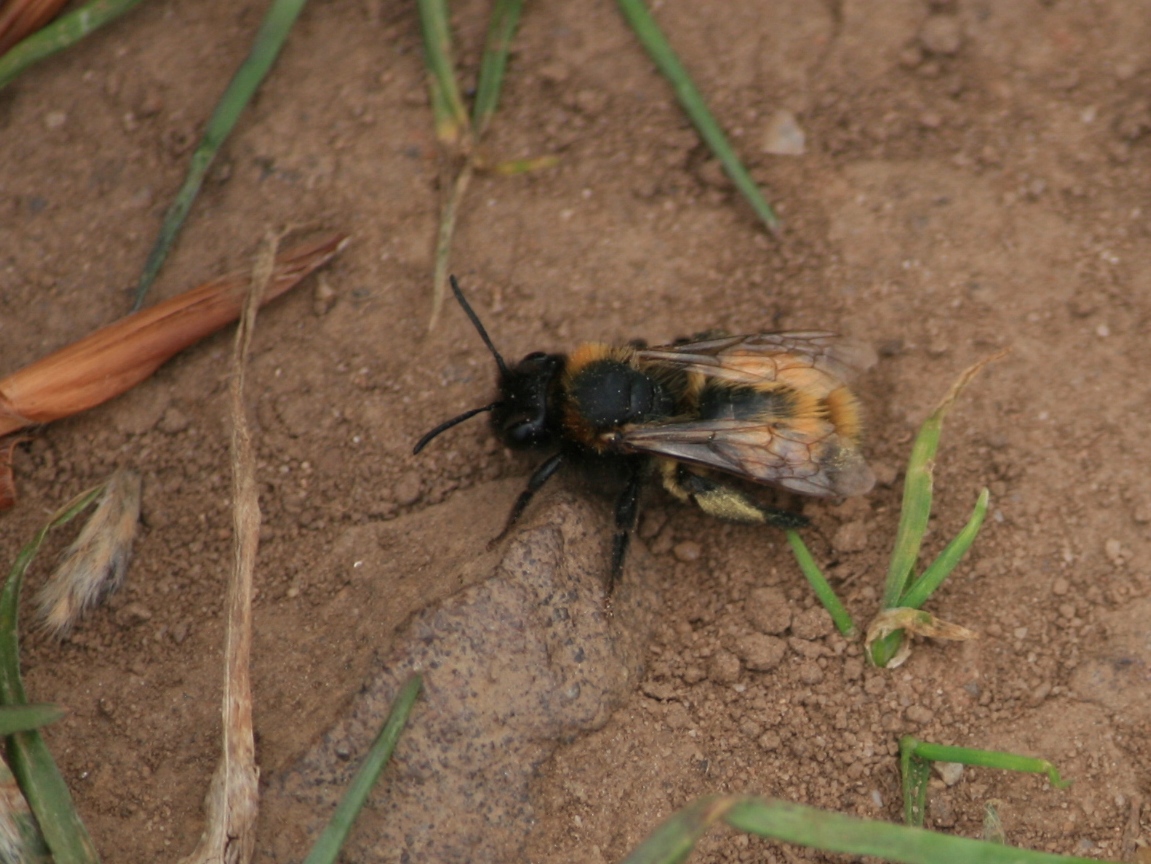
Mining Bee spp. Seen near Upper Holloway. 

After crossing a few sheep fields, as the clouds parted I joined the curving path from the road to the memorial and the trig point. The smell of may blossom filled the air. A Spotted Flycatcher and a pair of Bullfinch were about. I crossed the tracks of the Crich Tramway village, where, in different times, preserved trams take visitors on short rides.

Spotted Flycatcher at Crich. 


Now I must confess I hadn't known what the Pepperpot building which looks down on Matlock and Cromford from its commanding hilltop to the East actually was. A distinct landmark, unknown. It is a memorial to the soldiers of the Sherwood Foresters, a British Army regiment whose soldiers hailed from the Midlands. The men of the regiment served bravely in the First and Second World Wars, the unit's name is inscribed on many a war memorial hereabouts.   The memorial can be seen for several miles, and the views from the hill are commanding. Belper, Derby and the wider countryside spread out below me. I wasn't the only one there. A couple embraced on the grass beside the memorial. A sombre looking man respectfully took down the flags which flew at the site entrance for safe keeping as evening approached. 

View from Crich. 

Sherwood Foresters Memorial. 


I hung out with a handsome crow for a while, and had my lunch, and drank in the expansive vista, and some tea, and then I headed down again, via further woodland, where some fellow walkers were looking for a site used in the filming of the Children's drama 'Stig of the Dump.' I regret only the book was a part of my childhood, the 1981 and the 2002 versions both neatly avoiding me. 


Did Stig of the Dump wander among these Ramsons? 


I reached the Cromford Canal again as the sun was setting, and walked back, fish spotting. A huge, lone Perch, a neatly striped fish with two big dorsal fins more familiar as shoaling juveniles, big enough to be an ambush predator, hung motionless in the water. A few hundred yards on, I watched a Little Grebe fishing in the clear water, astounded by the speed they can do underwater. My word those things are fast. The terrors of the minnows. Clouds of Mayflies were hatching and danced in the evening sun over the water. 

Mallard on Cromford Canal. 

Mayfly Hatch on Cromford Canal. 

As I strolled back over the hills I reflected on how far I had just walked. 


Birds Seen: Canada Goose, Mallard, Tufted Duck, Little Grebe, Buzzard, Moorhen, Black Headed Gull, Lesser Black Backed Gull, Woodpigeon, Jay, Magpie, Jackdaw, Carrion Crow, Raven, Blue Tit, Great Tit, Swallow, House Martin, Long-Tailed Tit, Chiffchaff, Blackcap, Wren, Nuthatch, Blackbird, Song Thrush, Mistle Thrush, Spotted Flycatcher, Robin, House Sparrow, Dunnock, Grey Wagtail, Pied Wagtail, Chaffinch, Bullfinch, Goldfinch. 

Not Birds Seen: Brown Hare, Rabbit, Grey Squirrel, Brown Rat, Perch, Common Blue Damselfly, 

18th May 2020

Wirksworth to Carsington 

On a greyish, intermittently breezy day, I made my way via Stoney Wood, where abundant Dingy Skipper were on the wing despite the weather. There were a few fledgelings about, as Spring turns into Summer, a brood of robins up on the top path.  I continued down to Carsington, where the visitor facilities remained closed, that now familiar refrain, 'due to the Pandemic.' However a public footpath skirts the South-Eastern bank of the lake, according to my OS Map, and who am I to doubt it. It was curious to see the area around the visitor centre so abandoned, car parks empty and fenced off, Stones Island with its sculptures unattended, and the grass, normally host to families, noisy youngsters and playful dogs, now totally and utterly reclaimed by Canada Geese. Though a few small crowds of humans were pootling about, as well as the odd jogger, the Reservoir seemed to belong largely to fluffy Goslings and Spotted Flycatchers.  Willow Tits had fledged youngsters, encouragingly. This is a scarce species which seems to thrive at Carsington.


This walk was among the first in which no year nor lockdown bird list ticks were had. A Great Crested Grebe floated with some striped 'humbugs,' the distinctive young of this charismatic and familiar  water bird. 

Stoney Wood Bird Sightings: Jay, Jackdaw, Great Tit, Swallow, Nuthatch, Robin + Fledgelings, Goldfinch (Singing) 

Stoney Wood Butterfly Sightings: Dingy Skipper (5), Green Veined White (2) 

Carsington Water Bird Sightings: Canada Goose, Barnacle Goose, Greylag Goose, Mute Swan, Gadwall, Mallard, Great Crested Grebe, Grey Heron, Cormorant, Buzzard, Moorhen, Coot, Oystercatcher, Lapwing, Black Headed Gull, Common Gull, Lesser Black Backed Gull, Woodpigeon, Swift, Great Spotted Woodpecker, Magpie, Jackdaw, Carrion Crow, Willow Tit (+Fledgelings), Blue Tit, Great Tit, Skylark, Sand Martin, Swallow, Long-Tailed Tit, Chiffchaff, Reed Warbler, Whitethroat, Blackbird, Song Thrush, Spotted Flycatcher, Robin, Redstart, Dunnock, Pied Wagtail, Meadow Pipit, Chaffinch, Bullfinch, Goldfinch, Reed Bunting. 

Mammals: Grey Squirrel, Rabbit. 

Butterflies: Large (Cabbage) White, Green Veined White, Brimstone. 

19th May 2020

A Stroll to Bolehill (Contains description of predation) 

A breif hour or so out of the house in beautiful sunshine brought the unexpected. Beneath an old, gnarled Oak tree beside the footpath, a few small birds were feeding on the ground, a typical mixed crowd of tits and finches. A Great Spotted Woodpecker dropped in, I assumed to join them in preying in whatever small insects could be found there. Repeatedly it stabbed the ground, as the smaller birds took flight, chattering, and then it was up, with a small dead bird in its bill. Downy feathers drifted on the breeze. The bird, a Great Tit, was unceremoniously hammered into a crack in the bark by the Woodpecker's bill. The Woodpecker returned twice during the following ten minutes or so to peck at the carcass. An adult Great Tit was in the area with a food parcel for its youngster, one can but hope others survived. Passerine alarm calls abounded throughout.  Woodpeckers are not unknown to take young birds, hammered out nest boxes are a telltale sign of Great Spotted Woodpecker predation, but this was the first time I had witnessed it with my own eyes, and not of nestlings either, but of a fledgeling.

Distant view of the Woodpecker enjoying its meal. 


Plenty of other birds were busy with the business of raising chicks. Blue Tits fed chicks in a nest box on the wall of a house in Bolehill Village. A newly fledged Woodpigeon hassled a weary looking parent for food in a street tree, and robins were busy stuffing invertebrates into the yellow gapes of speckled fledgelings.


Friendly Sheep


I returned to the path beside the farm buildings, Ash Tree Farm or some such, and passed through a field of friendly sheep.  As I crossed the Ecclesbourne Valley Railway, a Sparrowhawk flew over, a kill in its talons. Swifts whistled joyously in the clear blue sky, themselves predators on the aerial 'plankton.' 

Birds Seen: Sparrowhawk, Woodpigeon, Swift, Great Spotted Woodpecker, Magpie, Jackdaw, Carrion Crown, Coal Tit, Blue Tit (+nest w/ young) Great Tit (+Fledgelings, one eaten by GSWP) Swallow, Blackbird, Robin (+Fledgelings) Dunnock, Chaffinch, Goldfinch


Sunday, 6 May 2012

Migrants and Babies in the first week of May

I’m off to Staffordshire tomorrow, in search of the holy trinity of woodland passerines Pied Flycatcher, Redstart and Wood Warbler. In view of that, and it having been a while since I last posted, I’m going to brave the slow desktop computer, substitute for a laptop which, it turns out, was far to fragile, to share a few highlights, from a week in which the sky remained ashen and the drizzle rarely abated, except to pour.

Saturday 28th April and the RSPB local group took us up to Paxton Pits in Cambridgeshire, in search of spring passerines, and other wildlife. Paxton is a sort of patchwork of beautiful wetland, scrub and open water, and, on the day of our visit, the wetland got wetter by the minute. Not long arrived from Africa, Swallows hugged the surface of the pits, as they hunted for insects taking their first weak wing beats of their adult lives above water. Swallows depend on flying insects and these tend to be hard come by in such wet conditions. One of the few places they still congregate is over water, and, as such, hirundines tend to gather over water when the weather is wet or turning. A single Swift, something of an early arrival, passed over our heads as we walked, and occasionally the fluid, musical notes of Nightingale, a species for which the reserve is particularly noted, could be heard emanating from the scrub. I must confess I have always found the nightingale somewhat overrated as a vocalist, finding blackbirds just as pretty, but yet having inspired, it seems, a somewhat smaller body of poetry. But there is something different about those notes, something bigger and fuller, a distinct quality of sound which sets the nightingale apart from other birds. Maybe it is something that has to be heard to be understood, and, like many musicians, is definitely best experienced live. Eventually a small, robin sized bird, a robin, it seemed, without a red breast, appeared on the ground behind one of the hides and started hopping around. Its back was chestnut brown and its underside a pale grey. Nightingales are often called drab, but that isn’t a word I’d use. They are impeccably smart, elegant, and very clean looking. They lack the bright colours of some related species of chat, yes, but there is something fine about their appearance as well as their voice.
Nightingales being the main attraction at Paxton Pits, we saw several other passerines, including several pairs of Blackcap, a few Common Whitethroat, lots of singing Robins and Blackbirds, and a very showy Willow Warbler. Resembling a Chiffchaff but with a much more tuneful, varied song, Willow Warblers are thought to be declining in this country, so this handsome individual, sitting on top of a hedge singing his heart out, was a very welcome sight. Walking around we came to the less pretty side of the reserve, where sand and gravel workings continue and signs warn visitors not to attempt to swim in quicksand.
In the afternoon I left the rest of the local group in the visitors’ centre, hiding from the drizzle, and glanced into the small pond outside the visitors’ centre. After a couple of false starts as little Smooth Newts came up for air, I made out the black shape on the stony bottom of the pond I was looking for. It was easily twice as long as the Smooth Newt, many times the volume, and looked jet black through the water. Eventually one came up for air and I saw the huge, deep tail of the Great Crested Newt, as it turned and dived under the water. It’s not a species I’ve really taken the time to see before, and it is quite impressive. There are few places I have come across where they can be observed just by looking, and where they cannot be observed by just looking they cannot be observed, being protected from disturbance by non-licence holders, such being their status under law, a necessary result of their increasing scarcity.
I ended the day at Paxton watching the Common Terns wheeling and diving, and chasing each other’s tails, over one of the pits. Three of these elegant white birds, with their thin wings and long tail streamers, were fishing here. One would dive for a fish, and then the other two would dive in for a tailchase, noisy, and demonstrating the agility of these birds in the air. I’d seen Sandwich terns battling with Arctic Skuas on a windswept Kentish beach before, and this was a similar display of the terns incredible agility, their quick turns, their ability to stop in the air and go into a dive almost instantaneously, over the green water and brown reed beds. If you happen upon some Terns, I would strongly recommend hanging about to have a look, they are well worth watching for a while. Many visitors were disappointed by the rain, which probably did limit the amount we could see, but I for one was satisfied with good views of a Nightingale, a number of passerines and my first encounter with the terns typical of these Atlantic shores since I was attacked by Arctic Terns on the Farne Islands in Northumberland last June.
Tuesday May 1st

Saturday May 5th and I took a walk around Upminster with a freind, starting in Clockhouse Gardens by Waitrose in St Mary's Lane. Here Feral Ducks mingled with wild coots and moorhens, and a brood of yellow Canada Goose goslings were catching the attention of several people. Clockhouse gardens is a small urban park with a small pond and carefully manicured flowerbeds, no doubt enjoyed by grazing geese and picked over by Moorhens. We continued onto Cranham Marsh where the calls of noisy Parrots mixed with the more melodious songs of Blackcap and Whitethroat, and passed through that lovely reserve to Parklands and Bonnets wood beyond, where Skylark could be heard. A Grey Heron and a kestrel flew over, and Apple Blossom provided a welcome spot of colour against the grey sky and among the mixture of cultivated trees which have been planted there.  

Sunday May 6th
and I went for a walk at Thorndon Country Park near Brentwood with the Matriarch. Mum spotted a pied wagtail as we left the visitors centre, but I missed this, though both of us saw a smart Great Spotted Woodpecker just a few paces later. Chiffchaffs and Great Tits sang in the canopy, but in the rain few birds could be seen as we walked the muddy woodland paths. The woods are truly coming alive now, the canopies closing as the spring leaf burst nears completion, and parts of the park were carpeted with nodding English Bluebells. We made our way to a hide beside a small lake, and a pair of blackcaps could be seen in the understory, disappearing into higher branches as we appeared. When we reached the hide we were entertained by three sweet little Mallard duckings, swimming at speed in all directions as their parents tried to keep up. The male Mallard was, unusually, also in attendance. A couple of Greylag Geese also had a little yellow gosling with them, sticking close. A pair of smart Little Grebes swam across the water in front of us, and there were a couple of pairs of Tufted Duck about. A show of parental defensive behaviour was put on by the Greylags when a Canada Goose came a little too close to the pair. The reaction was instant, both adults lowering their heads and hissing at the intruder. When he didn’t get the message immediately, one of the Greylags ran at him on the water, hissing and flapping, as the confused Canada hissed back, and lowered his neck too, until the Greylag pressed home his attack and he retired a few feet to a safe distance. Such was the speed and violence of the Greylag’s defensive action, I was breifly concerned for the welfare of the youngster, as the water was churned and splashed in all directions as the two Geese clashed. Once the Canada had retired a distance peaceful Greylag family life appeared to resume, and they made their way off, amongst the marginal vegetation.
A pair of grey herons nested among the trees by the water, the male bringing back food to his sitting partner. A few chaffinches fluttered about in the trees, and Jackdaws made entertaining noises with their contact calls in the treetops, as Grey Squirrels, typically, were everywhere. The rain probably kept most of the bird life quiet, but Thorndon's woods are special, and an overlooked habitat in a county probably best noted for its wetlands,  and well worth a couple of hours on a quiet afternoon.
saw me heading down to Stone near Bradwell on Sea in north-east Essex, and I took the opportunity to wander down the sea wall, past some beautiful and very friendly pigs in a field, to see what was about. May is an important time for migratory birds, with several species piling into the country for the breeding season, and I wondered if anything interesting might be found in this coastal spot. A line of shelduck flew over, and on the mud of the river Crouch were a few dozen Brent Geese. These birds were presumably stragglers from the huge flocks of geese which winter here on the Essex rivers. A handsome male wheatear, with a slate grey back and black bandit mask, perched on the sea wall, and some waders sat by a reed-lined pool inland of the sea wall. As they took off, most turned out, with the diagnostic white triangle on the trailing edges of their wings, but one, lacking these triangles, but similar in size and shape to its fellows, was probably a migrating Spotted Redshank. It was still, more or less, in its drab winter plumage. Round here, we rarely see their smart, black summer plumage, which they tend not to acquire until they have moved further North. A dunnock and a whitethroat sang in nearby bushes, and my attention was caught by a large, brown bird flying low over the reedbeds. It held its wings in a slight V, and had pale tan markings on its head. An unexpected Marsh Harrier was certainly a pleasant sight, as were two Avocets picking about daintily in the shallows. As I left I was fortunate enough to see a young fledgeling blackbird being fed by its father in one of the garden hedges, further sign that, while many long range migrants, like the Wheatear and the Spotred, were still very much on the move, our resident passerines were already well advanced with their breeding season.

Wednesday May 2nd was volunteering and Roding Valley again. We contended with the mud to build some steps for access, and were over flown by plenty of Swifts and Swallows, but what amazed me was how the lower fields by the River Roding itself were flooded, and flowing. There were lakes where the meadows should be. Periodic flooding is part of the history and the ecology of the meadows, depositing nutrient rich fluvial soils on the grassland. Often, these low lying meadows are host to abundant wild flowers and butterflies, but on Tuesday, they had mallards floating on them. A kingfisher flew out of an oak tree, hundreds of metres from where it would usually have lived, and over to vegetation emergent from the water, but previously standing on the riverbank. One of the volunteers wandered out a few metres and found the water approaching the tops of his wellies, and said he could feel the water flowing. No doubt, unless there is much more rain, the river will already have begun to return to its channel, but the nutrient levels in the adjoining fields may have been topped up. Walking in the fields after the work party, an adorable, big-eyed Harvest Mouse, the colour of wet straw, scampered out of a tussock and briefly into view, allowing us a glimpse of an infrequently seen small mammal.