Showing posts with label Grassland. Show all posts

Sunday, 28 March 2021

Wanderings in the Strangest Summer. Frampton Marsh, Lincolnshire, and Coombes Valley, Staffordshire.

 Frampton Marsh, 8th August 2020

On a bright and sunny day, with a fresh breeze blowing, Natty and I headed to Lincolnshire to join my old friend Brian at Frampton Marsh, the RSPB's fantastic, relatively new and expanding, reserve beside the Wash in Lincolnshire.

Spoonbills, and a Moorhen.


Here we were greeted near immediately by a flock of 17 or so Spoonbills, a sight which would have been unheard of just a few years ago, another brilliant white heron-like wetland bird establishing, or perhaps reestablishing itself,  in British wetlands. The birds largely kept their spoons concealed, tucked under wings out of the sun and wind. The flashes were covered in Knot, Dunlins, Black Tailed Godwits, the latter in all plumages from tango orange to ash-grey, as though dressed for the summer.'s funeral.  Among the waders Brian picked out a couple of Curlew Sandpipers, smart, dunlin-like waders with bold supercilliums.

Spotted Redshanks


We continued to enjoy a veritable late summer wader fest, with so many returning migrants from the far North and East, graceful Spotted Redshanks in their near white winter coats, so different in their movements to their commoner cousins, Common and Green Sandpipers, and a very smart Greenshank, his head nearly pure white. The breeding waders remained too, graceful, long-legged Avocets, brown patches on their wings revealing them to be the very same awkward, gangly chicks hiding from the rain among their parents' breast feathers just a few short weeks ago.

Whooper Swan and Common Tern


Shelducks floated about in their eclipse plumage, and a single Whooper Swan which had stayed the summer, perhaps too injured to make it across the North Sea though capable of flying back and forth across the reserve, lounged on an island in one of the freshwater lakes. The Spoonbill flock flew over, magnificent face spatulas forward, out towards the Wash.

Spatulas to the horizon!


There was not an overabundance of passerines, as one would expect at this time of year, with so many lying low to moult and enjoy the richness of the season, but yellow wagtails, in their muddy looking winter plumage, were active around the cattle, and a few swifts zipped about. Swallows and Sand Martins were ubiquitous. Emperor Dragonflies patrolled the ponds, and Common Darters the paths, while Small Tortoiseshell butterflies fed at the Scabious blooms. 

Common Blue Damselfly


Frampton is an incredibly special place. You should go there.

Small Tortoiseshell


Birds Seen: Brent Goose, Canada Goose, Greylag Goose, Mute Swan, Whooper Sean, Shelduck, Mallard, Teal, Pochard, Tufted Duck, Pheasant, Little Grebe, Great Crested Grebe, Spoonbill, Grey Heron, Little Egret, Cormorant, Moorhen, Coot, Avocet, Lapwing, Golden Plover, Little Ringed Plover, Whimbrel, Black Tailed Godwit, Knot, Ruff, Curlew Sandpiper, Dunlin, Snipe, Common Sandpiper, Green Sandpiper, Redshank, Spotted Redshank, Greenshank, Black Headed Gull, Common Gull, Herring Gull, Lesser Black Backed Gull, Common Tern, Stock Dove, Woodpigeon, Swift, Kestrel, Magpie, Rook, Carrion Crow, Skylark, Sand Martin, Starling, Yellow Wagtail, Pied Wagtail, Meadow Pipit, Linnet, Goldfinch, Reed Bunting.

Black tailed Godwit


Butterflies: Red Admiral, Meadow Brown, Gakekeeper, Small Skipper, Common Blue, Small Heath, Small Tortoiseshell, Green Veined White.

Ruff


Dragons: Common Blue Damselfly, Emperor Dragonfly, Common Darter.


Cinnabar moth caterpillars were numerous at Frampton. 


Coombes Valley, 9th August 2020

Of a warm but slightly overcast afternoon I went to Coombes Valley, in Staffordshire. It was surprisingly quiet, with few of the special birds out and about, perhaps down to the advancing season. However it was pretty, though a family insisted upon throwing pebbles into the stream where they Grey Wagtails breed. At least they were not building cairns and diverting the flow of water in the stream. Such disturbance in a habitat so small can have serious implications for its invertebrate diversity. A wasp was busy on the wood of the small bridge.


Wasp. 


I walked the Valley Woodland Loop, as the map called the circular footpath I wandered, and was surprised by the beautiful sight of three Red Deer- young stags- making their way among the trees. Each wore small, but different antlers in velvet. Deer often make their way through the woods at Coombes, but are seldom seen.

Freaky doll stuck to a Silver Birch tree. 


I picked up what my map called the 'Woodcock Trail' and was surprised to find Ling Heather, Calluna vulgaris once again, growing as an understory plant alongside Bilberry, Vaccinium myrtilis, as these species grow in much of their European range, but here associated with open heath and moor. I also enjoyed commanding views of the valley and the wider Stafforshire moorlands.  Someone had stuck a small plastic doll to a tree. 


The day ended with a spectacular orange sunset. 

Birds Seen: Sparrowhawk, Buzzard, Woodpigeon, Kestrel, Magpie, Carrion Crow, Coal Tit, Blue Tit, Swallow, Willow Warbler, Garden Warbler, Goldcrest, Nuthatch, Treecreeper, Blackbird, Song Thrush, Spotted Flycatcher, Robin, Bullfinch. 

Butterflies Seen: Peacock, Gatekeeper, Green Veined White. 


Friday, 1 January 2021

Wanderings in the Strangest Summer. Tittesworth Reservoir, 21st June 2020

 I accepted Natty's kind offer of a lift up to Severn-Trent's Staffordshire reservoir at Tittesworth, in the shadow of the Roaches, and was surprised to find the site heaving with people and their dogs, running everywhere including the foreshore, putting up the waders, including a small crowd of Oystercatchers, surprised and confused at their previously quiet habitat suddenly robbed from them. 
The woods were relatively quiet, and I escaped the throng as I walked away from the Visitor Centre. The carefully managed Wild Flower meadows were alive with meadow browns and Small Tortoiseshells, flying among the ox-eye daisies and the Orchids, and they were a beautiful sight in the sunshine.

Small Tortoiseshell, photographed in 2015. Diving into the archive to illustrate these as I was still waiting for my new camera. 


Most of the avian interest was to be found on the Western side of the Reservoir, where a patchwork landscape of copses and scrub, fringed by fenced off farmland, dominates. A disheveled and unwell-looking Willow Tit adult fed a noisy fledgling. According to the Collins, Willow Tit fledgelings produce loud begging calls, while the near-indistinguishable Marsh Tit is near silent in its youth.  The Willow Tit is a fast declining bird and it was sad to see the adult in such an unfortunate state, showing severe feather loss and the suggestion of avian pox around its face. I hope it survived long enough to see the youngster to independence and the disease was not transmitted between the two of them, as this charming little species needs all the breeding success it can get. 

A beautiful Little Ringed Plover scuttled back and forth beside the water's edge, and Common Terns fished gracefully. The banks were alive with midsummer flowers, foxgloves and Ragged Robin. 
I reconnected with Natalie and we paused a while on the Bridge, and watched a Common Sandpiper probing about in the mud, possibly a returning migrant. A distinctive shape, like an obese torpedo on hummingbird wings, a Kingfisher whirred by, as the Terns continued fishing in the open water.

A Kingfisher photographed in Suffolk in January 2020. 


Birds Seen: Canada Goose, Mallard, Tufted Duck, Great Crested Grebe, Grey Heron, Cormorant, Oystercatcher, Lapwing, Little Ringed Plover, Common Sandpiper, Black Headed Gull, Common Tern, Swift, Kingfisher, Magpie, Carrion Crow, Coal Tit + Fl, Willow Tit +Fl, Blue Tit, Great Tit, Swallow, Long Tailed Tit, Chiffchaff, Blackcap, Garden Warbler, Goldcrest, Wren, Blackbird, Song Thrush, Robin, House Sparrow, Pied Wagtail, Chaffinch, Goldfinch. 

Butterflies: Meadow Brown, Small Tortoiseshell, Green Veined White, Red Admiral. 


Friday, 20 November 2020

Wanderings in the Strangest Summer: Elton to Bradford Dale 17th June 2020

17th June 2020 


I took the short drive to Elton, not to be confused with the same name, once again, and parked near the church, where I was greeted almost immediately by a confiding young Song Thrush.  From here, and in pleasant weather, white cloud above, I crossed the farm fields where a magnificent Hereford Bull nuzzled affectionately with one of his cows. A glance signalled permission to cross, and I did so. I walked through meadows now teaming with Meadow Browns and Small Tortoiseshells, even on this overcast day.


Song Thrush at Elton


Then I crossed some 'improved' fields, ugly dayglo green dairy deserts, little more than lawns, with few butterflies. I waked past enclosed copses fenced in by barbed wire. Barbed wire was a feature only of the improved fields, curiously. I reached a rock-strewn slope and descended through the cattle, and paused to view a small pond, signs advertising it for angling, where coots and tufted ducks swam. The Eastern end of Bradford Dale was heavily managed and well trodden, but there were wild flowers down to the water's edge attended by smart Red Admirals and yet more Small Tortoiseshells.


The Eastern side, where I walked beyond the bridge in Youlgreave, was more wooded in character, though host to Grey Wagtails, swans, and an area of slow, crystal clear water designated for swimming. I walked into the woodland, in decreasing light, as storm clouds gathered. The river had historically been managed for fish, once on a commercial basis, and was divided into concrete pools, each holding a family of Mallards, some with large, near adult size juveniles, others with downy doughball ducklings. The weather was on its way, but still I paused to enjoy a Dipper darting in and out from a nest in some pipework where the river flows under a small arch bridge.


I took the footpath through some wetlands, across a camp site, abandoned for the time being, past a field of inquisitive bullocks, who walked in step with me on the other side of a fence, and reached a narrow road near one of a couple of places in the UK called Robin Hood's Stride. Here the heavens opened, and I found a memorial bench overhung with branches, I wish I could remember to whom it was dedicated, but to their family I am grateful, as from this bench I watched fork lightning split the sky, as the downpour drew on. Hares darted at the sound of thunder like gunfire, and cattle bellowed in their frustration, and gathered together around the loudest. Birdwatching was out of the window, butterfly spotting a laughable dream


When the rain alleviated a little, I made my way back to Elton. When it had stopped, I shivered. To my surprise, on my way back to Elton, I saw a Barn Owl, floating ghostly over the fields. Perhaps the rain had been so heavy mice and voles had been flooded out of their holes. It dived into the grass, stayed down a moment, and then was up again and flying. I reached for my camera, but found its viewfinder and LCD display frosted by condensation. 

I made my way back to my car, shivering, disassembled the camera, hopelessly it transpired, a victim of the deluge, on the passenger seat to dry. As I drove, another storm rolled into the green valleys.


Grey Wagtail


Butterflies Seen: Elton-Bradford Dale: Small Copper 1, Red Admiral 1, Small Tortoiseshell 6, Meadow Brown 29. 

Bradford-Alport: Small Tortoiseshell 8, Meadow Brown 1. 

Bradford Dale East: Red Admiral 1, Common Blue 1, Small Tortoiseshell 5, Meadow Brown 3.

Bradford Dale West (inclement weather) Green Veined White 1, Small Tortoiseshell 2.

Birds Seen: Greylag Goose,Mute Swan, Mallard, Tufted Duck, Pheasant, Buzzard, Moorhen, Coot, Woodpigeon, Barn Owl, Swift, Great Spotted Woodpecker, Kestrel, Magpie, Jackdaw, Carrion Crow, Blue Tit, Great Tit, Swallow, House Martin, Long Tailed Tit, Chiffchaff, Wren, Treecreeper, Starling, Blackbird, Song Thrush, Robin, Redstart, Dipper (visiting nest) House Sparrow, Grey Wagtail, Chaffinch, Goldfinch. 


Tuesday, 17 November 2020

Wanderings in the Strangest Summer, a Retrospective. Frampton Marsh and Freiston Shore

11th June 2020

With lockdown coming to an end, but my weekdays still luxuriously free, Natty and I celebrated our Anniversary with a drive out to the Lincolnshire coast, our longest away trip since March. We deliberately chose a grey day to avoid any crowds, though, as the weather deteriorated, we realised we may have chosen a little too well. 
Under a grey sky we walked from the car park down the main path toward the 360 hide, which remained closed, before pressing on toward the sea wall. Despite the cold winds, a Sedge Warbler put on a distraction display, posing on the wire fence, a response to a predator, distracting attention from the fledgelings in the reeds.

Sedge Warbler


In a creek on our right, a Spoonbill, crowned by its breeding plumes, pale yellow horseshoe marking emblazoned on its chest, emerged, and walked close to us, unperturbed by our presence. A stunning bird, once considered a real rarity, Spoonbills have begun to colonise Britain in recent years, but to see one so close and in its breeding finery was still a great privilege. A Little Ringed Plover, surprisingly well camouflaged against the mud, almost disappeared when it turned its back to us. It probed in the mud with its short bill, before flying off into the grassy marsh, the lack of a wing bar confirming its identity. 

Spoonbill


On the pool to the left of us were many Avocets with their chicks, big headed and gangly legged. Some took shelter beneath the wings of their parents, creating the impression of a six-legged bird, while the other parent was up mobbing a passing Gull. 
From the sea wall we watched displaying Redshanks, dropping on stiff downcurved wings, and calling eerily. Avocet parents mobbed us a little, flying close and noisily, and we made our way by as quickly as we could, to avoid creating any more disturbance or exposing the chicks to opportunistic and more confiding corvids and gulls. Perhaps reduced foot traffic during the lockdown period had allowed them to nest closer to the sea wall than they would otherwise have. 
The hedges are noted for their passerine avifauna, and I was looking forward to squinting into bushes for little brown birds, when it began to rain. Indeed, the heavens opened and all the birds were driven into deep cover. There was still plenty of birdsong, Natty's musician's ears identified 12 singing Yellowhammer, though I only heard three. The rain drove us onward to the sheltered stretch of public footpath, where the seeing was easier, and at least our binoculars could stay dry. A pair of Turtle Doves flew by, and damp, bedraggled hares stood hunched in neighboring fields. 
Beaten by the rain, Natty and I retreated to the motor, and then to Boston, where we picked up a fish and chip supper and headed to Freiston Shore. 

Birds Seen: Mute Swan, Greylag Goose, Shelduck, Shoveler, Gadwall, Mallard, Teal, Tufted Duck, Pheasant, Great Crested Grebe, Spoonbill, Grey Heron, Little Egret, Cormorant, Moorhen, Coot, Oystercatcher, Avocet, Lapwing, Little Ringed Plover, Black Tailed Godwit, Redshank, Black Headed Gull, Herring Gull, Lesser Black Backed Gull, Common Tern, Woodpigeon, Turtle Dove, Collared Dove, Swift, Magpie, Carrion Crow, Skylark, Swallow, House Martin, Sedge Warbler, Whitethroat, Starling, Blackbird, Meadow Pipit, Goldfinch, Yellowhammer, Reed Bunting.

Freiston Shore

We ate our chips in the car as the rain beat down on the roof, then took a brief walk down the path. past fledgeling blackbirds, baffled by what must have been their first encounter with heavy rain. A robin sang beautifully, but was wise enough not to expose itself to the harsh conditions. The hirundines were busy, hunting insects low over the water. Mist and rain limited our visibility, so we struggled to make out any waders a reasonable distance away. 
Freiston is in many ways a smaller version of Frampton, with freshwater lagoons and saltmarsh, but it does boast a clear view of the sea, something I had dearly missed over the past few months. 

Birds Seen: Mute Swan, Mallard, Grey Heron, Little Egret, Oystercatcher, Avocet, Black Headed Gull, Common Tern, Carrion Crow, Swallow, House Martin, Wren, Blackbird, Robin (H)   


Saturday, 10 October 2020

Lockdown Walks: A Retrospective. 5th May. Four Trigs.

 Apologies for the long delay in getting back to blogging, all good things must come to an end, including the longest summer, and I have now returned to work.  So the blog posts will remain relatively infrequent, but will continue. 

So, here goes. 

5th May 2020 Spring Wood, Carsington, Black Rocks, including four Trig Points. 

On a cool breezy day, I strolled out of Wirksworth toward Sprink Woods, at the time an unofficially accessible patch of woodland just across the fields to the South of the town. The trees were very quiet, but the woodland floor bloomed, especially in the patches of felling. Yellow Archangel, Forget Me Not, Wild Garlic, Red and White Campion, and Herb Robert all bloomed in the patches of sunshine. Unfortunately there was also a little litter, something which may have inspired the landowner to close off access to the wood a few days after my walk there.


I reached the Callow Road and proceeded to the Stainsborough Farm trig point, accessible across fields by two open gates. I descended toward Carsington Water, on the way encountering the distressing sight of a newborn lamb stuck fast between two barbed wire fences. I managed to lift out the tiny, wobbly creature, which was as light as one of my cats, and return it to the field from which it came. It doddered about and bleated. I did not see it reunited with its mother, and just got sheep milk poo on my hands and a bit emotional. Online approaches were made to find the farmer, such is the glory of technology, and hopefully the animal was okay.


RAF Hercules fly past. 

Great Northern Diver, Distant but distinctive. 


From the lamb I made my way down to Carsington  Water, by now bathed in sunshine after an overcast morning, and listened to the rhythmic, foot tapping stylings of Reed Warblers at the foot of the Reservoir.  The calm was broken by a very low flying RAF Hercules transport aircraft, whirring through the valley.  The Great Northern Diver, a juvenile which had spent the winter at Carsington, gave wonderful close views, showing its Hulk-like proportions, and the diagnostic neck markings which separate it from the other two species of Diver.  This is the same species of bird referred to in North America as the Common Loon, a reference to its haunting breeding call, a sound we do not hear at these latitudes. This wintering individual would soon return to the Northern sea lochs and fjords in which they breed, places to which the summer comes late. A Willow Tit also at Carsington was my first sighting of this declining woodland species, which thrives at the site, of the lockdown walks. 


Carsington Water from Carsington Pastures. 


I climbed up after my brief flirtation with the lake shore, through the hummocked fields of Carsington Pasture. A grumpy landowner was evidently keen for me to keep to the footpath, having made careful use of signage, and a muckspreader to dissuade me from leaving the path to have a sit down. The views from here were extraordinary, however, vast, across the reservoir. Skylarks and a beautifully plain Garden Warbler sang. Higher still, through the edge of Brassington Town, where people suspiciously eyed the stranger out in Lockdown, I climbed, to a picnic site where Orange Tip butterflies patrolled banks of vibrant blooms, then turned into a field where Early Purple Orchids bloomed, and my first Dingy Skipper butterfly of the season was on the wing.

Orange Tip (male)

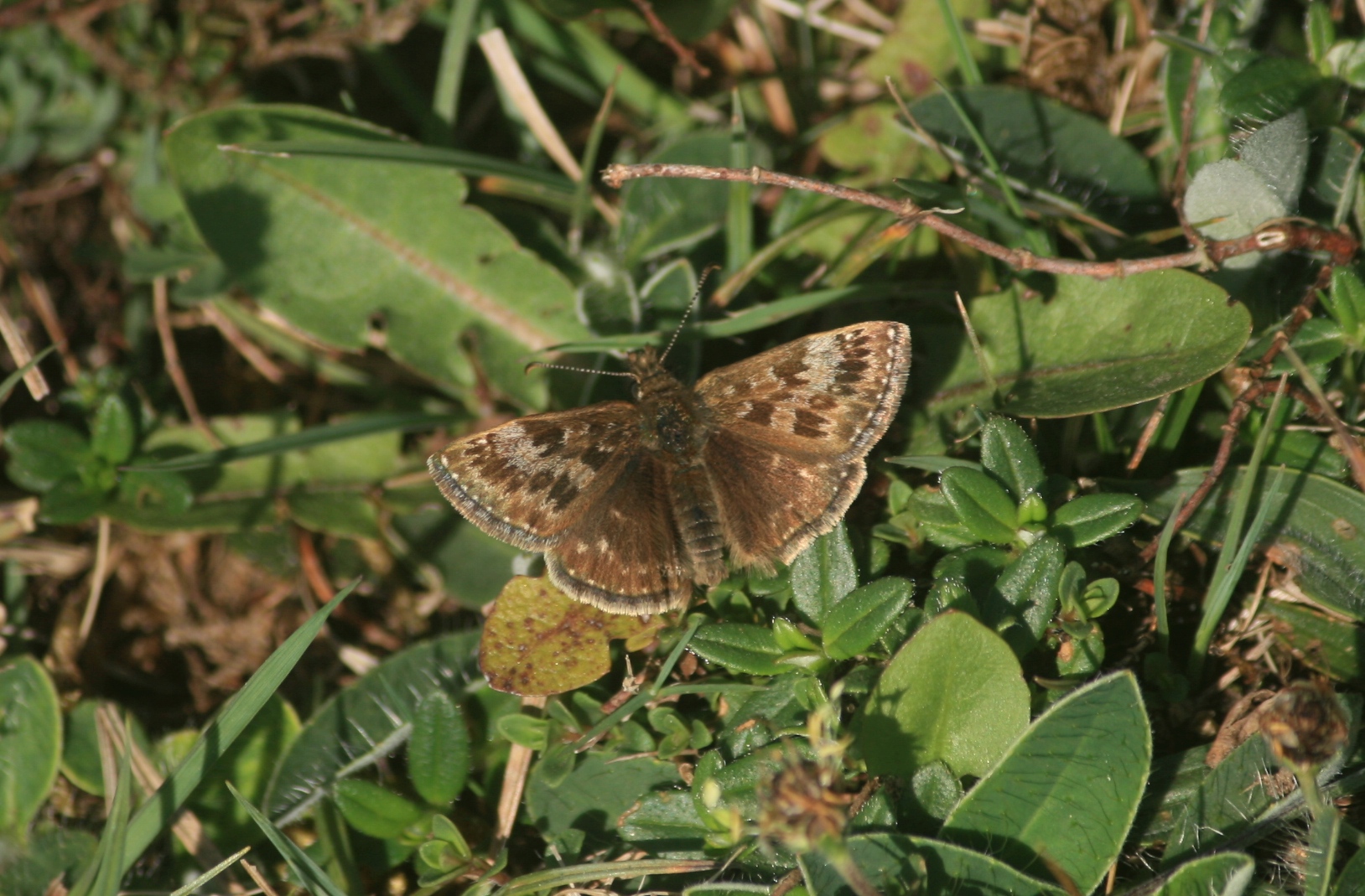
Dingy Skipper

Early Purple orchids and Cowslips


The factory which sits beneath Harborough Rocks was noisy again, in contrast to earlier visits in Lockdown where it had been silenced. Meadow Pipits and Skylark were in attendance around the trig point, the second of the day.


St Mark's Fly (Bibio marci)


I returned to the High Peak Trail and, with evening fast approaching, I enjoyed the sight and sound of plentiful Whitethroat and a glorious male Redstart once again close to the turning for the Middleton trig. As I walked away from it to reconnect with the footpath, Meadow Pipits took off in fright but did not leave the area, suggesting the proximity of nests on the ground. I will avoid the area in future so as not to risk disturbing these birds. I reconnected with the Wheatear pair behind Middleton Top Cycle Hire. The light had really begun to fade now, but the possibility of four trigs held rather more pull than perhaps it should, and I yomped to the fourth Trig at Black Rocks, even breaking a sweat, something I usually avowedly avoid while out strolling, to achieve my objective. I reached it with just enough light for a final selfie.  Bats flew in the gloom. I got back to my front door in darkness.


Harborough Rocks Trig Point. 

Moonrise over Middleton

Birds Seen: Canada Goose, Greylag, Gadwall, Mallard, Tufted Duck, Great Northern Diver, Grey Heron, Sparrowhawk, Buzzard, Moorhen, Coot, Oystercatcher, Lapwing, Black Headed Gull, Lesser Black Backed Gull, Stock Dove, Woodpigeon, Collared Dove, Tawny Owl (Heard only) Swift, Kestrel, Magpie, Jack, Rook, Carrion Crow, Raven, Coal Tit, Willow Tit, Blue Tit, Swallow, House Martin, Willow Warbler, Chiffchaff, Reed Warbler, Garden Warbler, Whitethroat, Wren, Blackbird, Song Thrush, Mistle Thrush, Robin, Wheatear, House Sparrow, Dunnock, Pied Wagtail, Meadow Pipit, Chaffinch, Linnet, Goldfinch, Reed Bunting. 

Butterflies: Peacock, Green Veined White, Orange Tip, Brimstone, Dingy Skipper. 

Mammals: Brown Rat, Grey Squirrel, Rabbit, Pipistrelle. 


Tuesday, 25 November 2014

I love South Essex


Strolling on West Canvey Marshes this morning, the flat, damp expanse of grazing marshes filling the space between the snaking mud channel of Pitsea creek, and the Canvey Way Avenue of Remembrance, as the A130 becomes when it crosses onto the “island,” and in the shadow of the huge former Coryton Oil Refinery, and its docks, I was struck by something. South Essex, you are flipping beautiful. Never change what you are.

Black Tailed Godwit at West Canvey Marshes

The water on the reserve was high, and there were puddles on the paths. These wet coastal meadows are a typical local habitat, sculpted by centuries of moderately intensive human land use, the coastal grazing marshes. The reserve is still, declare the information boards the RSPB have installed about, a working farm, and cattle graze its lush swards. The pool beside the A130 was attended by busy Black Tailed Godwits, prodding about on its grassy margins, and Lapwings stood on its banks.  The gentle mews of Common Gull, and the whistles of Wigeon, striking ducks with bold yellow stripes on tops of their heads seemed to fill the air, a winter chorus, despite the constant competition from the traffic just a few metres away.   These calls are evocative of the cold winter air, these birds have travelled from distant breeding grounds in Scandinavia, or Siberia, places compared to which these windswept marshes are relatively hospitable winter habitat.


I wander on as a trio of chirping Meadow Pipits fly overhead, more seasonal refugees from the uplands. Stonechats are here too, bold, striking and confiding. Stonechats watch you as you watch them. They seem to keep an eye on the observer, and occasionally take off to snatch one of the few insects still active in late Autumn, from the air or off the ground.  As I neared the next hide I was aware of the sky filling with birds, Godwit, all the ducks, Lapwings, and smaller Starlings, so often seen in the company of Lapwings on South Essex marshes at this time of year, and previously hidden among the long grass, all taking to the air.   Presumably disturbed by all the commotion, a Grey Heron joined them too.  They wheeled and climbed, alarm calls echoing, staying airborne, indicating the presence of an aerial predator. I could not spot one.  In the photographs of the flock the roofs of passing vans on the A130 are visible, but I was not aware of them at the time. This was wild Canvey. I sat down in the hide, and as I did so the birds began to settle again, Wigeon landing on the water en masse in front of me, hundreds of them.  A circling Marsh Harrier seemed too distant to be the cause of their collective alarm. A couple of ducks took off from the other side of the water, and a shape raced toward me across the water. I couldn’t make it out at first but within a few seconds I was eye to yellow eye with a Sparrowhawk. We seemed to hold each others’ gaze for a second as the raptor climbed a little, effortlessly, giving a piping alarm call of its own, and passed over my head, and over the top of the screen, dropping in behind a hedgerow somewhere between where I sat and the Oil Refinery, and was gone from view. I have no regrets about lacking the presence of mind to point my camera at it, that would have deprived me of the eye-to-eye moments I had with the bird, and the breathless, heart racing moment.  I hadn’t recognised the bird at first because its outline was broken by the dead starling in the hawk’s talons. This was a stunning wild predator, in a stunning wild landscape.

Flocking Wigeon, with passing traffic.

Walking down the path, between the hedges, crossing the bridge over the reed beds where a few short weeks ago Natalie and I had been watching the swallows gather to roost before their flight to sub-Saharan Africa, now long gone, I could not help but wonder at this oasis, and the beautiful, underrated part of the country into which it fits, the Estuary England, the South Essex Marshes. Like so many South Essex wildlife sites, West Canvey does not exist separately from the urban and industrial places which surround it, but merges seamlessly with them to form a wider landscape, continuous and stunning and interwoven.  It is not far from Basildon, and is one of a suite of marshes the RSPB helps to look after locally. Here and in the wider area, from Fortress Purfleet, known to the RSPB as Rainham Marshes and sitting West of the Dartford Crossing, to the wintering flocks of Brent Geese and Turnstone which hang around at high tide at the foot of Southend Pier in the East, and Wallasea and Foulness Islands beyond, both noted for their wintering raptors, these sites are settle easily into a landscape shaped by human activity along the river. So many, such as the chalk habitats at Chafford Gorges near Thurrock, once a chalk quarry, or the new invertebrate reserve managed by BugLife at Canvey Wick, home to rare bees and other invertebrates, once an oil refinery, exist on Brownfield sites, shaped by industry, and these industries existed here because of the river, connecting London with the open sea.

Stonechat on Canvey Island

South Essex, I thought, as I became surrounded by the squeaking contact calls of busy long-tailed tits around me, you are bloody gorgeous and I love you. Then I thought, oh look, a Goldcrest.
Pitsea Creek.


Wednesday, 19 March 2014

The Voles of Roding Valley

I want to share a couple of photos I took during my volunteering recently at Roding Valley Meadows. Roding Valley Meadows is a multiple SSSI reserve in Essex, not far from Epping Forest, and Chigwell, that bastion of Essex culture. It hosts floodplain meadows, a wetland, secondary woodland, a network of ancient hedgerows, and a very dedicated and hard working team of hands-on staff and volunteers. Occasionally I am privileged to join them on their regular work parties.  Kingfishers and Little Egrets are commonplace on the river Roding.  However, a week ago on Tuesday, the day that the sun came back and I saw my first Bumble Bee of the year, it was mainly covered in so many voles.


While we were building some fencing in advance of the arrival of the cattle which provide summer grazing on the open parts of the nature reserve, we accidentally disturbed some of the little furry mammals. It was with some surprise that rather than scattering, although they did run away initially, at least a couple of the voles returned to their grass cutting pile and the round holes in which they seemed to live. Noticing movement, I sat and watched for a little while, as a stubby, furry snout emerged from one of the vole holes. The tiny, round beast sat outside its hole for a moment, looking unperturbed, before finding a few blades of green grass growing from among the pile of cuttings, and beginning to munch on them.  If I moved too close with my camera lens, they would dart back into the hole, sausage-shaped blurs of vole hair, though not for too long. Eventually, my watching began to make them clearly unsettled, and one discovered the tactic of biting off a strip of long grass and retiring with it, into the vole hole. The tip of the grass, protruding, wobbled as the vole munched. I left them to it and got back to work.


As I wandered away at the end of a busy day fence building, passing the long hedges of white blackthorn, the first wild blossom of the Spring, I was aware of several voles moving in the leaf litter, seeing another, quite clearly between the blossom covered branches, munching something busily in the leaf litter. I’d heard a rustle and been looking for a small bird as the source of the sound.  A couple of paces on another darted into the long grass. Perhaps at a local scale they are having a good year, they are a species prone to strongly cyclical population dynamics. My observations were entirely unscientific, perhaps I was merely more tuned in to their presence than usual, or perhaps, I just saw a lot of voles that day.   But it struck me how seldom we actually see these creatures. The short tailed field vole is thought to be the only mammal in the British Isles to outnumber humans, yet I was at University before I noticed that I had seen one which wasn’t in a Longworth trap.  They live outside of our radar, though of course many mammals and birds of prey, including Barn Owls and Kestrels, are almost totally dependent on them as a source of food.  It also struck me that they are very beautiful.