Showing posts with label Environmental. Show all posts

Tuesday, 28 July 2020

Continued. A retrospective through my lockdown walks.

Stoney Wood and Environs Thursday 2nd April 2020

A walk was had of a clear and bright but somewhat blustery afternoon, up through Stoney Wood, where there were several large bumblebees on the catkins, and then taking the second footpath off the hairpin bend on the Dale. Stoney Wood is a favourite local spot, and a community woodland on the site of an old quarry. There were no new migrant birds, somewhat to our surprise, but there were Chiffchaffs, Blue and Great Tits, and chaffinches, all singing. 

We then wandered onto the shorter of the two footpaths across the Middle Peak Quarry, through a tunnelled section, and then picked up the road toward Carsington. Another footpath on our left brought us back through Middle Peak quarry. A few walkers were out and about but humans remained somewhat scarce. Blackthorn, Celandine, and huge mats of some herbaceous plant with white flowers clung to the quarry walls. 

Birds seen: Lesser Black Backed Gull, Black Headed Gull, Stock Dove, Woodpigeon, Jackdaw, Carrion Crow, Coal Tit, Blue Tit, Great Tit, Long-Tailed Tit, Chiffchaff, Wren, Blackbird, Dunnock, Pied Wagtail, Goldfinch. 

Bolehill, Cromford Canal, Black Rocks, Cromford Moor.   Friday 3rd April

A Longer circular walk was had this afternoon, taking the now familiar trail up from Wirksworth, past the parked historic trains, up the hill into Bolehill, through the village, along the farm track and down a network of footpaths through a pastoral landscape of spring lambs and shy cattle. I spent a little time with a beautiful, one eyed black cat, who was very friendly and affectionate. I rather wanted to bring him home. A Skylark sang. I reached the canal and looked for waterfowl, but found it all surprisingly poor, both on the canal and the derwent. Unusual. I then struck up the steep part of the high peak trail, and made my return via Black Rocks, and part of Cromford Moor, which hosts a fragment of moorland vegetation but is largely disappearing under conifer plantation. 

The view from the Cromford Moor trig point did not disappoint and I stopped for an obligatory selfie up there. as the sun broke out. The view took in part of Carsington Water in one direction, with the White Peak beyond, and the flat land toward Derby in the other. Cromford Moor was a surprising beauty, and something of a revelation and a discovery, but a few hundred metres from my home.

Birds Seen: Mallard, Pheasant, Little Grebe, Moorhen, Buzzard, Woodpigeon, Jay, Magpie, Carrion Crow, Raven, Blue Tit, Great Tit, Skylark, Long-Tailed Tit, Chiffchaff, Wren, Treecreeper, Blackbird, Fieldfare, Redwing, Song Thrush, Robin, Dunnock, House Sparrow, Pied Wagtail, Chaffinch, Goldfinch 

Cromford Moor

Part of the view from Cromford Moor Trig.

Descent via Bolehill, with Micropigs. 

Rail Transport through the 80s. 


Middleton Moor, High Peak Trail, Black Rocks and Bolehill.   4th April 2020

Another lockdown walk took me to Middleton Moor via Stoney Wood and the vastness of the Middle Peak Quarry, passing around abandoned or near abandoned farm buildings and a large stand of gorse. Middleton Moor, seldom explored by me, is something of a misnomer. On the limestone, it consisted largely of highly improved grassland, and held a few Meadow Pipits, and Skylarks sang from on high. 

Further down the High Peak Trail a Peregrine circled overhead, and Natty and small human joined me at the National Stone Centre. We climbed the steep footpath up Black Rocks to the Cromford Moor Trig Point I'd visited alone the previous day. The view was still good. I suspect it will take a while to get old. 

We walked back through the Shetland Ponies and spring Lambs near Bolehill. 

Birds: Pheasant, Lesser Black Backed Gull, Kestrel, Peregrine, Jay, Magpie, Jackdaw, Carrion Crow, Blue Tit, Great Tit, Skylark, Chiffchaff, Wren, Blackbird, Song Thrush, Mistle Thrush, Robin, House Sparrow, Pied Wagtail, Meadow Pipit, Goldfinch. 


Home. 5th April 2020

On a day spent mainly at home, Goldfinches were busy in the bushes, and were house sparrows. Black Headed Gulls flew over and a Peacock Butterfly was in the garden. An afternoon stroll about town added Greenfinch to the Lockdown List, and we also saw a Bombus lapidarius. A Buzzard was in flight over the town and the first Herb Robert was in flower. 

Part of Middleton  Moor. 

Sunday, 5 May 2013

Lydd Airport Expansion


Finding time to blog is sometimes a bit of a challenge.  This is why I am blogging about an announcement made now several weeks ago. On the 10th of April the news broke that permission had been granted for Lydd airport to be expanded, a measure which will may conclude the story of Dungeness’ National Nature Reserve’s “Death from a thousand cuts” to quote the expression once used by the botanist Brian Ferry, who has worked extensively on the site.
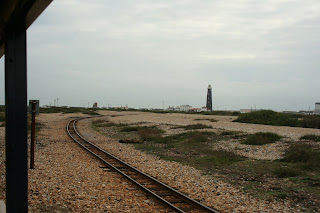

Dungeness Old Lighthouse from the RH&DR narrow-guage railway.


Dungeness, announced as “the other lands end” by a sign welcoming visitors to the expansive National Nature Reserve and ramshackle fishing community, is a totally unique habitat, with no parallel existing anywhere in the world. It consists of miles of shingle, bound by a community of lichen and bryophytes, grazed by a few hardy rabbits and hares.  It shows a complete succession from a maritime flora of rare Sea Kale, a curious, salt-tolerant member of the cabbage family, up to scrub, established on soils left behind by lichen and bryophyte pioneers, an example of life finding a way on a stony desert of rounded pebbles deposited by the sea. Wild flowers grow among the simpler plants and lichens, and in high summer these are visited by a range of butterflies, small tortoiseshell, small heath, small copper.  A single road winds across the foreshore, past the two lighthouses, historic and modern, past the Pilot Inn, serving local fish and chips, past the old coastguard cottages housing the Dungeness Bird Observatory, my home for five weeks in the Autumn of 2010, toward the dual towering, steam emitting monstrosities of Dungeness A and B nuclear power stations. A small footpath cuts north in a straight line across the shingle, past a memorial two a couple of brave Polish lads who died in their Spitfires defending the English coast, a threadbare polish flag flying over the wild, flat shingle country. A series of lakes,  traces of the gravel extraction workings which dot Romney Marsh are attended by herons, and in Autumn, swallows and martins gather over them in their thousands, surround an old cart track, where the lichen flora is barer, and where one can experience jelly legs after hours spent walking over the unstable shingle, which leads up to the famous RSPB reserve, home to the most obliging birds of prey in the country, a population of Marsh Harriers, a bird described by the lands custodians as rarer than a Golden Eagle. Yellow wagtails and meadow pipits breed here, and the reserve hosts black redstarts, specialists in these extreme habitats, and a rare colony of Tree Sparrows.  The gravel workings present an opportunity for migratory birds passing through the area from Great Britain, Ireland, Scandinavia, and even Iceland and Greenland, through the migration bottleneck the peninsula presents, on their way to the Mediterranean and beyond. From the lighthouse the ridges and troughs, landforms typical of an apposition beach, can still be seen, creating interest for Geomorphologists as well as Ecologists.

Rare Lapland Bunting at Dungeness.


Lydd airport as it is now is fairly inoffensive. Light aircraft fly out of it, pleasure flights take in the beauty of the channel coast and the Kent countryside. But the news of impending airport improvements threaten all of this, and, wooed by the promise of a meagre 200 new jobs (according to the Guardian’s transport columnist) local opinion is spilt, although a poll suggested 2/3 people would still rather not see their treasured NNR disappear, and are opposed to the airport expansion.  More concerningly, the scheme has been approved by government who claim, despite all the scientific evidence to the contrary,  that the airport scheme will not damage local wildlife.  This is a clear falsehood, as the RSPB, and Professor Ferry, of whose teaching I had the honour when I was an undergraduate at the University of London, would testify. The Sulphur dioxide pollution associated with jet propulsion causes increased nitrogen deposition to the soil, to which lichens, complex symbioses of algae and fungi, specialists in nutrient-poor environments, in which the two organisms depend on each other to survive, are particularly vulnerable.  The increased nutrient levels will destroy the unique plant communities and the succession.  The RSPB manages its reserve for birds, and flight safety legislation may prevent them from managing in such a way as to encourage them. The Wildlife and Countryside act protecting wild birds from hunting does not apply where there are flight safety issues, and any birds perceived as presenting a danger to flights will probably be shot.  Lydd Airport expansion, for Dungeness and its wildlife, means death.  The RSPB has been campaigning hard against airport expansion, with petition after petition, and even calling in the initial approval of the scheme to judicial review.  Their case was that the nature conservation value of the area was overlooked by the planners, which is clearly true. Nevertheless the judiciary sided with the business cartel.  The airport is owned by the charming Sheikh Fahad el Athel, who was once in court over millions of pounds of commissions involved in weapons deals between BAe and his native Saudi Arabia, who complains the runway.

Cricket among the shingle at Dungeness.

The government seems intent to force upon us some new airport building in the near future, despite widespread campaigns to the contrary. They support their war on Ecology through the use of academic stooges such as the Ecosystems Markets Task Force, a group, tellingly composed of economists, who claim it is possible to offset damage caused by commercial building projects simply by directing conservation effort, funded by developers, to other sites, equivalent to licensing an individual to destroy the Mona Lisa and replace it with a picture of a smiley face. Dungeness is irreplaceable, as the barren shingle “habitat creation” projects at Sussex Wildlife Trust’s Rye Harbour reserve demonstrates. Such habitats, and the landforms which accompany them, cannot be created artificially. This deserves another blog, but ridiculous exercises in market-based approaches will sound the death knell of the British conservation movement if they are permitted to get any further. Nevertheless they will try and fall back on such guidance notes.  Meanwhile Hundreds of loyal, Tory-voting West Londoners have succeeded in convincing the government not to expand Heathrow, with the help of well meaning green campaigners. Few of us see the need for increased airport capacity, and much as I love aeroplanes, and the opportunities for travel they provide, I acknowledge we need to reduce, not increase our capacity if we are to reduce carbon dioxide emissions and minimise the coming climate disaster. Campaigners, including those at the climate camp in 2005 I had the honour of attending, have done well, but using Heathrow as a focal point for protest is problematic, as it risks diverting development to places they can do much more damage, places like the Thames Estuary, and Cliffe. Places like Lydd.  The truth seems to be, although many West Londoners appear curiously reluctant to adjust to the jet noise which has been going on above their heads, usually since before they were born, Heathrow may just be the least worst place for this environmental tragedy to play out. Not Dungeness. We would all rather it didn’t happen anywhere, but so called green campaigners who talk of airports “in unpopulated areas” are really doing biodiversity no favours at all.
View across Dungeness to the Nuclear Power Station.

Now it seems the campaign against the airport, and to save Dungeness, could have found a pair of very unlikely friends. When it is next in court, as the RSPB will, with widespread support, ensure it will be, the main focus may be in the area of Nuclear safety.  Large aeroplanes and nuclear power stations present a fairly obvious safety risk and security challenge, and, especially in these days of paranoia, the risk of aeroplane-reactor collision, and all the associated fallout, are a real concern.  A blight on the beautiful landscape may yet, ironically, save it.  If not, one can hope that the legal fees will eventually build up sufficiently that the business interests whose endless greed would see this green, windswept paradise of bird life and lichen erased forever, will be put off by the mounting cost. The possibility remains that the cost of building the airport at Lydd will eventually prove prohibitive. We must not be complacent, campaigns continue to prevent it. It is not over, and it may yet go to court in Europe, where, as a designated SPA site, UK equivalent of the Natura 2000 network, the planning authorities will have to demonstrate that the airport, is in the vital national interest.
Small Copper butterfly and Cladonia lichen

What is in the vital national interest is preserving this unique, and incredibly fragile and vulnerable wildlife habitat.
View across Romney Marsh from the RSPB reserve.

Tuesday, 22 January 2013

Gateway to the Nuclear Wasteland?


The government is planning to dump nuclear waste in Cumbria, on the doorstep of the stunning Lake District National Park, and,  perhaps unsurprisingly given this knowledge, Saturday took me up to the town of Bowness in Windermere on the shores of the lake, to demonstrate.

The lake district is a remarkable landscape, its precipitous crags, high rolling hills and still, deep lakes inspiring poets over the centuries. Indeed, their descriptions were such that probably very little more is needed. The point is that Cumbria is remote, and as such, it lends itself all to readily to sites like this. The infamous Sellafield power station sits on the Cumbrian coast,  where it is processes nuclear waste from around the country, and beyond.  Suggestions of releases of radioactive material causing cancer in domestic pets and poisoning the catch of Norwegian fishing boats have never quite been proven but we all know they have been made.
Lake Windermere, Cumbria.


Current plans are to site a nuclear waste dump in West Cumbria, perhaps inside the National park, perhaps outside, the precise site is not clear. Previous surveys and reports have revealed concerns about the Geology of the area. The ideal site for a repository of nuclear waste repository, if such a thing exists, would comprise hard, non-porous rock, in a geologically stable area, under low relief.  West Cumbria was rejected for just such a dump in the late 1990s, at which point our government made advances toward to government of Australia to consider siting said waste there.  Unsurprisingly, their advances were rejected. And so the plan came back to Cumbria.  The rocks of West Cumbria sit about the Lake District Boundary Fault, which has produced tremors in historic time, and historic time isn’t that long in the lifetime of some of the country’s most dangerous nuclear waste.  It is not far from the places in which Britain’s adventures in Fracking shale gas will soon be commencing, the practice which caused such phenomena as burning tap water and earth tremors in the United States, dismissed in Britain as the result of “poor regulation.”  They also lie under some of the subterranean aquifers which provide water for some of the most populous parts of Western Europe- Greater Manchester depends on the Cumbrian hills for its water supply, as does much of the North West.  The Lakes are famous, too, and welcome millions of tourists from far and wide. Some local businesses can be forgiven for their concerns that some of their would-be customers may remain further South for fear of the nuclear waste. 
Dayglo Standards.


Those supporters of nuclear waste dumping in Cumbria, including the few local councillors who declared, much to the surprise of the people they represent, that the communities were “willing” to accept it, claim that “jobs” will be available to the local people, although they are less forthcoming about how many. These will largely be in digging out the holes in which the waste is to be stored, it is unclear whether they have accounted for the personnel needed should there be a serious radioactive accident.  Accidents and near meltdowns are dismissed by the nuclear lobby as something that only happens abroad, where workmanship is inexplicably considered poor, and management even worse. The Fukashima plant in Japan may have been poorly maintained, but what is Japan?  This is the land of the public private partnership, the Ladbroke Grove Rail Disaster and the filthy hospital, the land which would never fail to adequately maintain its vital safety equipment.  If the most technological advanced country in the world cannot safely deal with nuclear power, what is to be said for a country whose engineering record since the 1950s consists mainly of entries in Richard Hammond’s Book of Crap Cars?  The Cumbrian site, which leading geologists say is unsuitable, which was dismissed as unsuitable twelve years ago, will be accepting waste from all over Europe and perhaps beyond.


The problem remains of somewhere to site our domestic nuclear waste, especially following the decision to build a new generation of nuclear power stations as an alternative to coal and gas. I do not have any answers to this problem, but the consensus remains, that Cumbria is not suitable. With that in mind, a few good friends from Lancaster People and Planet gathered on the shore of England’s largest lake, the stunning Windermere, in the heart of the Lake District, and an icon of the country’s natural beauty, with concerned locals, to wave banners and sign petitions, and have a presence to express our profound anxiety pending the conclusion of the public consultation on Friday.  The demo was extremely friendly, a small crowd of fifty or so people from the local community gathered among the pigeons and jackdaws and ice in a beautiful place. Day-Glo flags stood in a row on the jetty, and it was disheartening but appropriate to realise they spelled out the word “Sold” against the backdrop of the Mute Swans and still water, snow-capped hills behind. Banners declared “no nuclear waste facility for the lakes” and beer mats, handed to passers by promoted the demo and declared that the nuclear waste was “for you, for eternity” a play on some marketing strategy used by the National Park Authority.  We signed some petitions and agreed to bring some literature back to Lancaster to make people more aware of what was occurring.
Mallards, Black Headed Gulls, Mute Swan, Feral Pigeon.


There were some hardy souls out , or some dedicated ones, who hung on in the cold for an hour or so. It was good to see some colour and hear some music, in aid the hope it would contribute to the cancellation of this frightening project. They were a good crowd and seemed pleased to meet the Lancaster crowd. After the demo we dispersed a little bit, some of our band making their way to a lovely little cafe up the road in Bowness, while three of us stayed a little while, to look at the bird life (this is, after all, a birdy blog, here comes the birdy bit...) and reflect on the potential impact of the development on this stunning place.  Mute swans and mallards ate out of the hands of demonstrators and tourists.  Further out on the water floated Tufted Ducks, and in the distance, smart Goldeneye, another diving duck, gathered in a flock, their white bodies and cheek patches separating them from the more familiar tufties. A couple of Goosander were about, a female swimming up and down not far from us.  Further out was a bright white drake goosander. This species used to be pretty scarce, perhaps partly as a result of historical persecution by fishery interests, but seems to be in the process of making a comeback. Goosander are big ducks, slightly larger than a mallard, and sit low in the water. Their toothed bills, they are among a sub family of ducks known as sawbills, mark them out as fish-eaters.  Unlike the Mohawk of the co generic Red Breasted Merganser, their crests are thick and give the impression of an oddly shaped head.  Also out there was a familiar bird I hadn’t seen yet this year, a great crested grebe. This common species had somehow evaded me this year and it was nice to see one out here.  I’d always thought of the lakes as something of an avian desert, host to plenty of wildlife, sure, remarkable invertebrates in the woods fringing many of the deeper, oligotrophic waters, and in the sediment of Windermere’s shallows. I’ve always been aware of remarkable fish, ice age relics like the Vendace and Arctic Char which live in the deep, cold waters, but I was under the impression these mesotrophic (like Windermere) and oligotrophic (like most of the others) lakes were of relatively little value for birds; their true wildlife value lying beneath the surface, but here was a good assemblage of species.
Mute Swan


A couple of swans strutted and waved their heads and necks in a courtship dance.  Someone got out a packet of Mini Cheddars, and within seconds, she was covered in pigeons. Handsome, white doves, none other than leucistic feral pigeons, descended in dozens.  The mute swans, clearly very familiar with people, climbed cumbersomely out of the water, and waddled towards us. Black headed gulls took up perches on the railings beside us. We’d watched other people feeding the birds, and then getting intimidated by the pigeons, and I’d always felt a little smug about it. I enjoy watching feral pigeons,  I find their behaviour fascinating and just think they’re very watchable, so I wasn’t adverse to borrowing a mini cheddar myself and crumbling it a little, offering it to a handsome white pigeon. Immediately the bird took up position on my arm. Several others surrounded me, perching on my back, my head, arms, shoulders. They felt very light, their wing feathers, even as they flapped about, very soft, but one of the birds beaks felt quite hard as it pecked me in the face. I didn’t look so smug and handed the Mini Cheddars to someone else, although not before we’d all posed for photos with the pigeons.
The Author With Pigeons.

Leaving the birds and the waterside behind we headed up to the cafe, and for an explore of Windermere and Bowness, and their outdoor shops. It was a great day. We’d stood up for something good, and we’d made friends with some pigeons. A couple of beers and a snowball fight later and we hit the train back to Lancaster.

Edited To Add: Links to petitions on 38 Degrees:

http://you.38degrees.org.uk/petitions/no-nuclear-dump-in-the-lake-district

http://you.38degrees.org.uk/petitions/stop-plans-for-a-nuclear-dump-in-the-lake-district

And for the benefit of Laura's bird notebook:

Canada Goose (Branta canadensis) Mute Swan (Cygnus olor) Mallard (Anas platyrynchos) Goldeneye (Bucephala clangula) Tufted Duck (Aythya fuligula) Goosander (Mergus merganser) Great Crested Grebe (Poediceps cristatus) Carrion Crow (Corvus corone) Jackdaw (Corvus monedula) Feral Pigeon (Columba livia) Common Gull (Larus canus) Black Headed Gull (Chroicocephalus ridibundus) Cormorant (Phalacrocorax carbo) Collared Dove (Streptopelia decaocto)