The day after the day spent with Peregrines I took the
opportunity to catch up with an old friend. Cheryl and I met in Greece working
for the HOS and she had recently returned to town after some time away. We
decided, in lieu of a proper plan for the day, to head down initially to the
Irwell to have a look at the Peregrines. As we wandered down toward the river a
couple of tweeting passerines flew over us, which transpired to be
Goldfinches. Reaching the river, we
could, with bins, still see a couple of the slate grey juveniles up on their
ledge. Here at ground level the feral pigeons still went about their business,
oblivious to the predators perched high above them. Still fed by their parents,
the juveniles seemed to be having it fairly easy, and did not seem bothered by
the meals-on-wings service beneath. A couple of Black headed gulls hawked about
above the water, and some Canada Geese and their Goslings sat contentedly on
the bank. We stood, and did a bit of
urban birding.
 |
| A Mancunian Feral Pigeon |
As we stood watching the raptors, a blue shape flew low
across the water like a shot. A kingfisher? I thought so, although I couldn’t
find it again. An orange shape in the bushes could have been the front of a
kingfisher, but turned out to be that of a robin. Where we stood, literally,
was in the centre of a city, one of England’s biggest, in the shadow of tower
blocks and shopping centres. The water must’ve absorbed several shopping
trolleys, and only one bank was vegetated, with Elder, Willowherbs and Buddleia,
and this trampled to mud in places by the Geese who roost there. The other
bank, made of concrete, plunges directly into the water. There was nothing
about this place to make it a wildlife site, nothing tangible, it was just
another grotty urban water course, brown and polluted.
A grey wagtail rose out from under the bridge and fluttered
off across a hotel car park, flashing its yellow belly and the white edges on
its tail to us as it climbed away. Perhaps it was nesting down there. The real
star birds, however, were on the water. With dark brown heads, and substantial
punky crests, a two Goosander, possibly two females or juvenile birds, swam out
from beneath us and hauled themselves out alongside the Canada Geese. The Goosander is a species of duck, a
merganser, with a shape which calls to mind that of a cormorant. Its beak had
tooth-like structures which grasp the fish on which it feeds, and is a lot
thinner and narrower than the beak of a mallard or similar dabbling duck. These two were lazy, and just hauled up next
to the Canada geese. The Goosander is a bird I associate with wide bodies of
water in winter. It occurred to us they might have escaped from some private
collection, but according to the RSPB Goosander breed on the Irwell and at other
places in the area. Yet here they are,
hanging out near a Peregrine nest in the middle of a city.
 |
| Goosanders and Canada Geese in Urban Manchester |
It was heartening to see these birds thriving here in the
city. It is a city somewhat impoverished with green spaces, although not around
the outskirts as the rest of my visit would prove. Urban birding, David Lindo
style, can reveal some interesting species. Positive management for wildlife in
Manchester and other cities undoubtedly makes a contribution, as does the
unlikely ability of some species to adapt to urban conditions. It is worth noting that the Peregrines are
here in part as a result of great efforts by the RSPB and other institutions.
After our urban experience Cheryl and I met up with my good friend Tom and headed off to the Chorlton Water Park on the bus. Despite the wonderful wildlife I was starting to get the mild crazies I do from being in a built up area for so long. The bus to Chorlton took about twenty minutes and we walked through the leafy residential streets to the River Mersey. Crows and anglers hung out on its banks and the ubiquitous Canada Goose was about but this river, despite its green banks, is somewhat less well managed than the Irwell on the edge of Salford. The emergent and marginal vegetation looked to have been cleared with a mower, leaving only stark, ugly sloping banks. There seemed to be no rhyme or reason to this nonsensical management. Marginal vegetation is vital to most of the characteristic riverside wildlife, such as dragonflies which need the stems to haul themselves from the water, and water voles who use it as both food and shelter. It also helps to reduce the power of flowing water and minimise the risk of flooding. Mindless vandalism would be a good word to describe the management of this stretch of the Mersey, or perhaps it is part of a plot with the Manchester rain to cause heavy flooding in Liverpool.
After our urban experience Cheryl and I met up with my good friend Tom and headed off to the Chorlton Water Park on the bus. Despite the wonderful wildlife I was starting to get the mild crazies I do from being in a built up area for so long. The bus to Chorlton took about twenty minutes and we walked through the leafy residential streets to the River Mersey. Crows and anglers hung out on its banks and the ubiquitous Canada Goose was about but this river, despite its green banks, is somewhat less well managed than the Irwell on the edge of Salford. The emergent and marginal vegetation looked to have been cleared with a mower, leaving only stark, ugly sloping banks. There seemed to be no rhyme or reason to this nonsensical management. Marginal vegetation is vital to most of the characteristic riverside wildlife, such as dragonflies which need the stems to haul themselves from the water, and water voles who use it as both food and shelter. It also helps to reduce the power of flowing water and minimise the risk of flooding. Mindless vandalism would be a good word to describe the management of this stretch of the Mersey, or perhaps it is part of a plot with the Manchester rain to cause heavy flooding in Liverpool.
 |
| For the sake of completeness, dire management on the River Mersey. |
 |
| And Better. Chorlton Water Park LNR. |
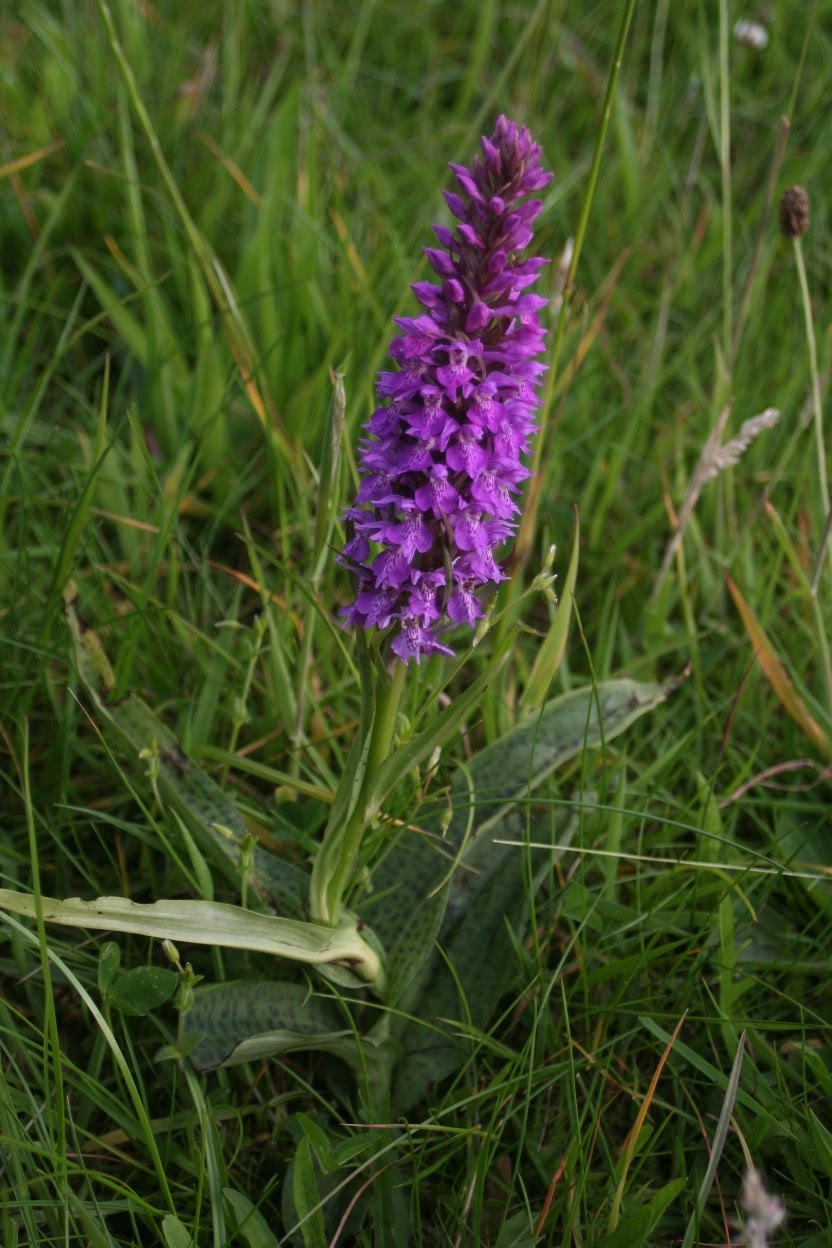 |
| Common Spotted Orchid |
A few Swifts and Sand Martins whistled about in front of us over the water. A kestrel hovered somewhere and a grey heron flew past on broad, slow wingbeats. On the water we could see a large, white looking duck. On closer inspection it proved to have a Green head and a narrow red beak. A male Goosander! Unfortunately he was too distant to give us a decent picture, but remarkable to encounter this species twice in one day.
As we walked down to the river, in the fading light and heading towards the pub, a large bird of prey rose up from in the nature reserve, pursued by a mobbing Carrion Crow. It was a Buzzard. Another bird of prey which was until so recently so scarce, is now thriving on the urban fringe. It felt like countryside here, so the bird did not look out of place, but at the water park nature reserve it was easy to forget how close we were to the city still.
Yeah, there’s a fair bit to see up in Manchester. An unlikely birding destination. We walked back to Chorlton and the bus stop through the woods, where well managed rides lined with silver birch took us to an old track which led back into town.


