Finding time to blog is sometimes a bit of a challenge. This is why I am blogging about an
announcement made now several weeks ago. On the 10th of April the
news broke that permission had been granted for Lydd airport to be expanded, a
measure which will may conclude the story of Dungeness’ National Nature
Reserve’s “Death from a thousand cuts” to quote the expression once used by the
botanist Brian Ferry, who has worked extensively on the site.
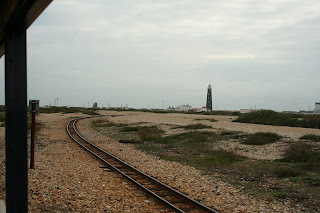 |
| Dungeness Old Lighthouse from the RH&DR narrow-guage railway. |
Dungeness, announced as “the other lands end” by a sign welcoming visitors to
the expansive National Nature Reserve and ramshackle fishing community, is a
totally unique habitat, with no parallel existing anywhere in the world. It
consists of miles of shingle, bound by a community of lichen and bryophytes,
grazed by a few hardy rabbits and hares.
It shows a complete succession from a maritime flora of rare Sea Kale, a
curious, salt-tolerant member of the cabbage family, up to scrub, established
on soils left behind by lichen and bryophyte pioneers, an example of life
finding a way on a stony desert of rounded pebbles deposited by the sea. Wild
flowers grow among the simpler plants and lichens, and in high summer these are
visited by a range of butterflies, small tortoiseshell, small heath, small
copper. A single road winds across the
foreshore, past the two lighthouses, historic and modern, past the Pilot Inn,
serving local fish and chips, past the old coastguard cottages housing the
Dungeness Bird Observatory, my home for five weeks in the Autumn of 2010,
toward the dual towering, steam emitting monstrosities of Dungeness A and B
nuclear power stations. A small footpath cuts north in a straight line across
the shingle, past a memorial two a couple of brave Polish lads who died in
their Spitfires defending the English coast, a threadbare polish flag flying
over the wild, flat shingle country. A series of lakes, traces of the gravel extraction workings which
dot Romney Marsh are attended by herons, and in Autumn, swallows and martins
gather over them in their thousands, surround an old cart track, where the
lichen flora is barer, and where one can experience jelly legs after hours
spent walking over the unstable shingle, which leads up to the famous RSPB
reserve, home to the most obliging birds of prey in the country, a population
of Marsh Harriers, a bird described by the lands custodians as rarer than a
Golden Eagle. Yellow wagtails and meadow pipits breed here, and the reserve
hosts black redstarts, specialists in these extreme habitats, and a rare colony
of Tree Sparrows. The gravel workings
present an opportunity for migratory birds passing through the area from Great
Britain, Ireland, Scandinavia, and even Iceland and Greenland, through the
migration bottleneck the peninsula presents, on their way to the Mediterranean
and beyond. From the lighthouse the ridges and troughs, landforms typical of an apposition beach, can still be seen, creating interest for Geomorphologists as well as Ecologists.
 |
| Rare Lapland Bunting at Dungeness. |
Lydd airport as it is now is fairly inoffensive. Light aircraft fly out of it, pleasure flights take in the beauty of the channel coast and the Kent countryside. But the news of impending airport improvements threaten all
of this, and, wooed by the promise of a meagre 200 new jobs (according to the
Guardian’s transport columnist) local opinion is spilt, although a poll
suggested 2/3 people would still rather not see their treasured NNR
disappear, and are opposed to the airport expansion. More concerningly, the scheme
has been approved by government who claim, despite all the scientific evidence
to the contrary, that the airport scheme
will not damage local wildlife. This is
a clear falsehood, as the RSPB, and Professor Ferry, of whose teaching I had the
honour when I was an undergraduate at the University of London, would testify.
The Sulphur dioxide pollution associated with jet propulsion causes increased
nitrogen deposition to the soil, to which lichens, complex symbioses of algae
and fungi, specialists in nutrient-poor environments, in which the two
organisms depend on each other to survive, are particularly vulnerable. The increased nutrient levels will destroy
the unique plant communities and the succession. The RSPB manages its reserve for birds, and
flight safety legislation may prevent them from managing in such a way as to
encourage them. The Wildlife and Countryside act protecting wild birds from
hunting does not apply where there are flight safety issues, and any birds perceived
as presenting a danger to flights will probably be shot. Lydd Airport expansion, for Dungeness and its
wildlife, means death. The RSPB has been
campaigning hard against airport expansion, with petition after petition, and
even calling in the initial approval of the scheme to judicial review. Their case was that the nature conservation
value of the area was overlooked by the planners, which is clearly true.
Nevertheless the judiciary sided with the business cartel. The airport is owned by the charming Sheikh
Fahad el Athel, who was once in court over millions of pounds of commissions
involved in weapons deals between BAe and his native Saudi Arabia, who
complains the runway.
 |
| Cricket among the shingle at Dungeness. |
The government seems intent to force upon us some new
airport building in the near future, despite widespread campaigns to the
contrary. They support their war on Ecology through the use of academic stooges
such as the Ecosystems Markets Task Force, a group, tellingly composed of
economists, who claim it is possible to offset damage caused by commercial
building projects simply by directing conservation effort, funded by
developers, to other sites, equivalent to licensing an individual to destroy
the Mona Lisa and replace it with a picture of a smiley face. Dungeness is
irreplaceable, as the barren shingle “habitat creation” projects at Sussex
Wildlife Trust’s Rye Harbour reserve demonstrates. Such habitats, and the
landforms which accompany them, cannot be created artificially. This deserves
another blog, but ridiculous exercises in market-based approaches will sound
the death knell of the British conservation movement if they are permitted to
get any further. Nevertheless they will try and fall back on such guidance
notes. Meanwhile Hundreds of loyal, Tory-voting
West Londoners have succeeded in convincing the government not to expand Heathrow,
with the help of well meaning green campaigners. Few of us see the need for
increased airport capacity, and much as I love aeroplanes, and the
opportunities for travel they provide, I acknowledge we need to reduce, not
increase our capacity if we are to reduce carbon dioxide emissions and minimise
the coming climate disaster. Campaigners, including those at the climate camp
in 2005 I had the honour of attending, have done well, but using Heathrow as a
focal point for protest is problematic, as it risks diverting development to places
they can do much more damage, places like the Thames Estuary, and Cliffe.
Places like Lydd. The truth seems to be,
although many West Londoners appear curiously reluctant to adjust to the jet
noise which has been going on above their heads, usually since before they were
born, Heathrow may just be the least worst place for this environmental tragedy
to play out. Not Dungeness. We would all rather it didn’t happen anywhere, but
so called green campaigners who talk of airports “in unpopulated areas” are really doing biodiversity no favours at all.
 |
| View across Dungeness to the Nuclear Power Station. |
Now it seems the campaign against the airport, and to save Dungeness, could
have found a pair of very unlikely friends. When it is next in court, as the
RSPB will, with widespread support, ensure it will be, the main focus may be in
the area of Nuclear safety. Large
aeroplanes and nuclear power stations present a fairly obvious safety risk and
security challenge, and, especially in these days of paranoia, the risk of
aeroplane-reactor collision, and all the associated fallout, are a real
concern. A blight on the beautiful
landscape may yet, ironically, save it.
If not, one can hope that the legal fees will eventually build up
sufficiently that the business interests whose endless greed would see this
green, windswept paradise of bird life and lichen erased forever, will be put
off by the mounting cost. The possibility remains that the cost of building the
airport at Lydd will eventually prove prohibitive. We must not be complacent,
campaigns continue to prevent it. It is not over, and it may yet go to court in
Europe, where, as a designated SPA site, UK equivalent of the Natura 2000
network, the planning authorities will have to demonstrate that the airport, is
in the vital national interest.
 |
| Small Copper butterfly and Cladonia lichen |
What is in the vital national interest is preserving this unique, and
incredibly fragile and vulnerable wildlife habitat.
 |
| View across Romney Marsh from the RSPB reserve. |


