Thursday, 15 March 2012

Derbyshire part II

After breakfast, and some more time spent around Cromford, Natalie and I decided to head over to Darley Dale and enjoy the manageable but not insubstantial (for suburbanites) hike uphill to Beeley Moor, where some local birders had given us a heads up some Brambling (Fringilla montifringilla) had recently been seen close to a farm, and a Great Grey Shrike was to be seen higher on the moor.

We stopped in Darley Dale, and, barely having begun our trek uphill, decided to take five in a park in the town to have our lunch. Here, a pair of bullfinches, the male a bright salmon pink, became our first of these for the day. Crows and Jackdaws were calling everywhere and the daffodils and crocuses in the park had begun to flower.

On our way up the long stretch of winding lane we paused at a noisy cluster of Scots Pine (Pinus sylvestris), a plantation tree, to see what birds we could find. There was a robin singing in it and Coal Tits (Parus ater) were numerous and my partner saw her first goldcrest. these pretty, active little charmers are not uncommon but their small size and arboreal habits tend to make them a little hard to see unless one has become tuned in. Once you meet a goldcrest, you tend to start finding them everywhere.

Other species we ran into on the way up included a lovely pale-phase buzzard, almost Osprey-like in appearance, accross the valley, active, feeding Nuthatches, smart, noisy Jays, their calls, reminiscent of cinematic dinosaurs, echoing through the trees. Most of the little birds we investigated, however, still turned out to be Blue and Great tits, which are ubiquitous. As we reached the farm where we'd been tipped off about the bramblings, we spotted a couple of chaffinches, flying between a line of trees and the ground, and scanned about for their Northern visitors. A smart, black and orange finch alighted in the high forks of one of the trees, the light catching his bright orange breast. Inevitably he flew as soon as the camera was pointed at him! We saw a few of these species before a change in the landscape ahead spurred us on.


Beeley Moor is actually moorland. Tussocks of Calluna vulgaris or Ling Heather mingle with Purple Moor Grass and other typical species. A carpet of moss lies beneath the heather canopy and different mosses and lichens of several colours cover any exposed pieces of rock. The only birds we saw here on the top of the moor were a small flock of Linnet (Carduelis cannabina), the Shrike eluded us.  There is a stirring sense of beauty about the moors, I was fond of walking on them as a child when I'd visit my Grandparents in the Yorkshire pennines. On Monday, however, the wildlife highlight was definitely the botany, and the sense of space which comes with being on the moors. The emptiness. So much of this habitat has been lost to "improvement" for pasture, and the addition of fertilisers favouring grasses which outcompete the heather, but what is left retains its sense of awe and magic. Under a blue sky we reluctantly turned and headed downhill. A couple of birds made us jump as they rose from the heather beside the road, and these were the moorland specialist Red Grouse, (Lagopus lagopus scoticus) 


Unfortunately our enjoyment of the spectacular sunset descending on the wild open hills of the peak district was curtailed a little as we were forced to run for the bus! The beauty of the peaks made us stop repeatedly to take photos, as the sunset haze and the mist began to obscure the big landscape,  but we had to remind each other of the need to catch the train to Stoke on Trent, from which we would head out into the Staffordshire Moorlands to continue our adventure.


As I write the summer sun streams through my windowk, burning off the dawn mist, and I feel inclined to keep this fairly breif. I shall be bringing the birdy details of my rather exciting trip to the North Midlands to you in installments.

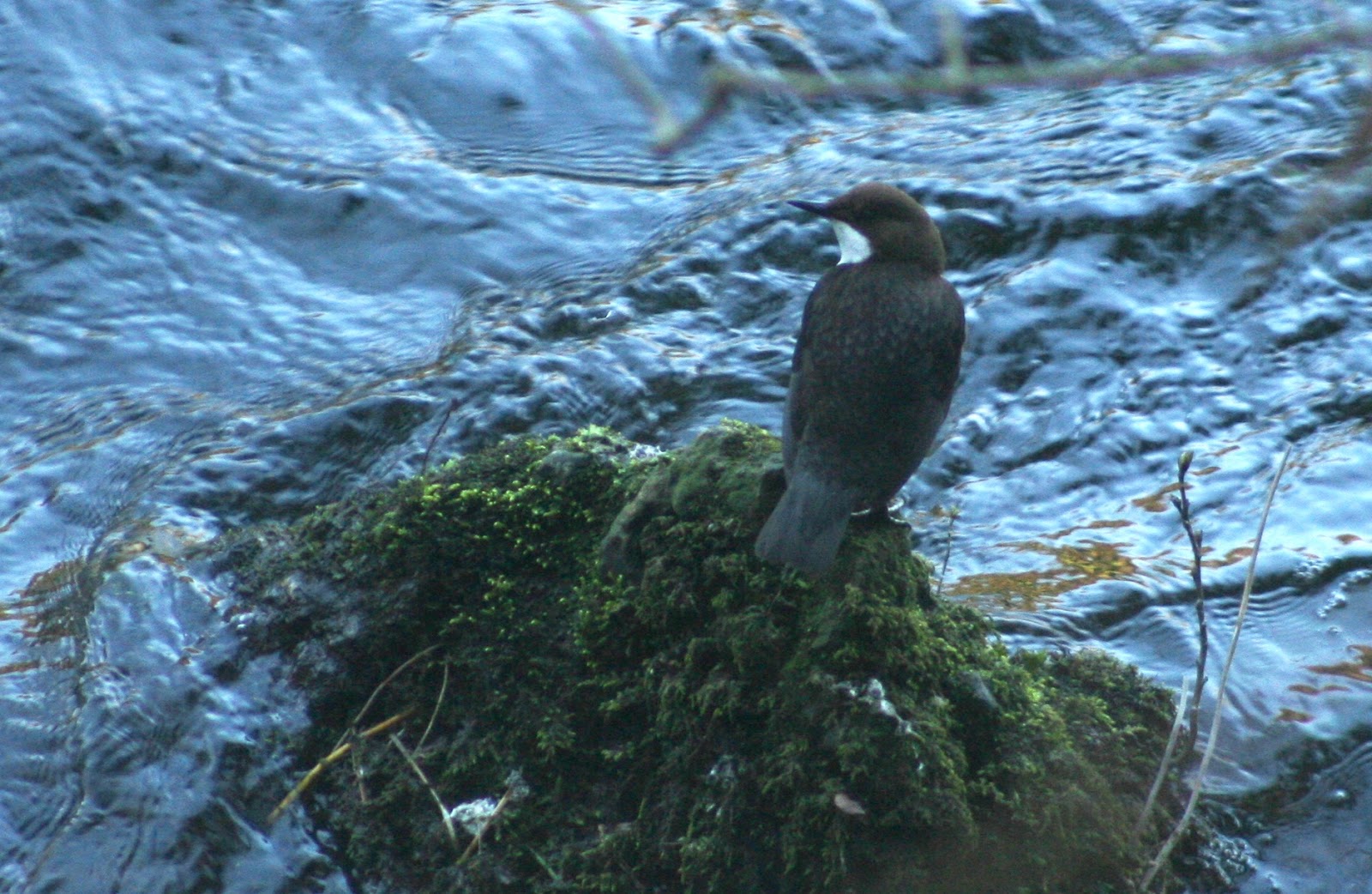
My partner and I arrived in Cromford, Derbyshire at about half past four, giving us limited light. We stepped off the bus near one of the famous Derwent Mills, mills very much of Blake's Satanic variety, covered in a bloody history of industrial accidents. Beside it, flowed a wide, fast river, at the bottom of the valley. The valley wall in front of us was under a gentle, landscaped parkland, with a variety of exotic-looking trees. We glanced over the wall and down at the flowing water. A couple of moorhens (Gallinula chloropus) prodded about on the opposite bank, but it was the small bird, blackbird sized, which flew by on whirring wings which caught my eye. He alighted on a rock where the river bends. He was fat and dark with a white chest patch. A dipper, and we had only been off the bus for a few minutes! We walked down a bit further and through the branches of imported pine trees, no doubt planted on the orders of some 18th-century champion of industry, to see the dipper raise his head and sing up at us, making a curious shape, his beak thrust vertically into the air, displaying with his chest patch. A female, or perhaps a rival, looked on with interest.


We decided to do a little more birding while we had the light but saw little, although a walk by the canal was pleasant and we were entertained by hot air balloonists in the valley. We watched a few mallards and mute swans for a bit on the canal and saw a pair of handsome Little Grebes, (Tachybaptus ruficolis) by now in their full, smart breeding plumage. A Mistle Thrush made rasping noises in a bush beside the water, and a large hen Sparrowhawk flew over our heads. The light began to fade so we decided to call time on the birding and contemplate dinner.

Natalie and I booked into our hotel and went out for the evening, taking care not to stay out too late and forcing ourselves out of bed before seven. She had chosen this place because she knew it was home to a bird I had never seen but yet one I was very keen too. The Hawfinch (Coccothraustes coccothraustes) is an increasingly scarce bird, a little bigger than a chaffinch, heavy set around the beak, with a large head and chestnut brown markings. Some birders told us where to look for them but a walk by the Rugby Club car park, where the other birders waited, just felt cold, and as I have always taken a mobile approach to birding I saw no reason to stop then! We tried the churchyard, where, after looking at several chaffinches through our binoculars, we finally found one of the heavy-looking finches. The beak, immense and triangular, is striking, and then the colour is unique, a smart, rich grey brown.


satisfied with seeing this remarkable bird we retired for breakfast and formed our plans for the afternoon. Apparantly there was a great grey shrike up on the moors, and, intrigued more by the prospect of moorland than the shrike, we decided that this was the way to go.

TO BE CONTINUED.

Saturday, 10 March 2012

Perseverence!

I am on something of a mission to romantacise the wetlands of South Essex, and the industrial complexes into the shadow of which they all too often fall. I find that Thames path so beautiful, and I only discovered it a couple of days ago, as it snakes between the wide open river and the gentle marshes. Today I got on my bike after lunch, rediscovered its higher gears and hurled it along the meandering paths of the Ingrebourne Valley, around the low slopes of Ingrebourne Hill, which rang with the sound of what seemed like at least three duelling techno skylarks, and down into the throng and traffic of Rainham "Village," where a smart Mallard stood upon an upturned shopping trolley in a tiny patch of Reed swamp, a Rainham Marshes "Proper." From here I took the sustrans path across the corner of the Nature Reserve. No Short Eared Owl today, however. The sky was blue, and calm. I was going to see the Bearded Tits. Linnets perched on the perimeter fence of the landfill site. 


As I arrived in the reserve, I noted threatening changes in the weather. The wind picked up, and the sun dissappeared behind a wall of cloud which had risen up from the other side of the railway lines, and as the cloud rose, and lyrics from a Crowded House song played ironically in my mind, my doubts rose.

As I walked past the reedbeds, I spoke to a couple of birders wandering along the path, who all told me that the bearded tits had been showing well an hour ago, but hadn't been seen since. The wind rose still, and, had you asked me then, I would have told you it was the point I knew I wouldn't see them. Possibly ever. I was a little heartened to see a couple of adorable little grebes apparantly beginning to display to each other among the reeds.  I wandered back and forth a little and heard a rustle at my feet. I looked down, and into the reeds, hoping to see perhaps a water vole, or some other mammal, harvest mice have apparantly been seen in the reeds on the reserve before. At no point did I expect to see, part concealed by the stems of the reeds, a female Bearded Tit. They flew along a little and I was joined by a couple of other birders, with their 'scopes and cameras, and eventually both birds appeared and began feeding on one of the Typha seed heads, scattering the fluffy seeds everywhere. The male bird had a bright yellow beak, very conspicuous, and a huge moustache, like a cartoon Mexican cowboy, on his blue-grey face. They were a little larger, perhaps, than a long tailed tit, and were very active, throwing the fluff of the Reedmace about all over the place.


  By now however the reserve was beginning to close. I'd taken loads of photos, and as I left the drawbridge at the visitors centre and Fortress Purfleet was being locked down for the night. Security there for a patch of wet grassland and a "Big Sky" seems a bit excessive. I paused at a spot where some old wooden benches had been placed for a view. The sun found a break in the clouds, and I looked at what is a large expanse of wet grassland and phragmites swamp. A peacock butterfly flew by and a couple of bumblebees attended the few early spring flowers. A robin was singing and the grass of the marsh looked very green, it will only be a few weeks before the new phragmites begins to emerge replacing the brown of last years growth. The skies were indeed huge, and the wide flat marsh spread out underneath me, very even outside of the land enclosed by the main path and boardwalks. Suburbanised indeed! The RSPB has shown genius in allowing the public access to only part of the reserve. A few mute swans were grazing on the open country and my little perch afforded the best views in the house of the Godwit flock. I hoped for a raptor but I saw none.

I reached the Ferry Lane end of the reserve and crossed the access road -Coldharbour Lane- into the other section of the reserve. I paused a little, watching the sun go down, and engaged in breif but freindly conversation with other passing birders and a local gentleman with a can of lager. And fair play to him, a beer would have gone down nicely.


I completed my day with another race home against the light.

Friday, 9 March 2012

Purfleet Marshes

This afternoon I decided to take a stroll around the RSPB's reserve at Purfleet, which they call Rainham Marshes, and everyone else calls Purfleet Marshes, on account of its location. I was optimistic as I boarded the train at Upminster station, there was a bit of a breeze but nothing to prevent a good day's birding. However it didn't take long waiting on platform "-12b" as the broken display called it, at Barking station, for my mood to start sinking. A strong breeze had started to build up  Low cloud seemed to press down on me like a grey hangover. As I arrived on the reserve I found myself without my tobacco, and had to return to the station to buy some more. Returning to the road I locked up my bike and, passing an interesting leucistic Woodpigeon (Columba palumbens) and a number of Goldfinches at the feeding station and trudged off in search of the elusive Bearded Tits (Panarus biarmicus) which, I am told, appear in the reeds just beyond the first hide. I've been looking for them several times, and have told that they crop up when you least expect them too. My mood already tinged with pessimism, I wondered whether that should make me hopeful. Evidently, in fact, it made me too hopeful, and despite trudging up and down the path by the reeds they were said to inhabit, I found nothing. Not a pinging call or a rich fawn brown back disappearing into the reeds, nothing. I felt a single drop of rain fall against the back of my hand.
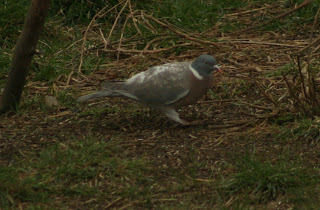
Odd Woodpigeon.


Even a singing Skylark (Alauda arvensis) as I approached the old shooting butts did little to brighten my mood. I had descended into birding despondancy. I kept walking until I passed the dragonfly pools and reached the monstrosity of the rifle butts "hide," effectively a small contemporary house with large windows overlooking the pools. I got distant views of a couple of Avocets (Recurvirostra avocetta) in front of a large flock of Black Tailed Godwit (Limosa limosa) on the target pools, and saw some of the usual waterfowl, Shelduck, Mallard, Shoveller, Mute Swan...But nothing out of the ordinary. The Peregrine was absent from his usual pylon, and a murmuration of starlings flocking and swirling around as they came to roost on another pylon were one of the few highlights of my walk back to the centre. It never came on to rain, and at the time I thought rain would have been better than this bank of cloud and close, muggy atmosphere. A nice Little Egret let me get up fairly close, and take a couple of blurry photos before he was off over the water. A very smart drake Pintail dabbled in the shallows of Aveley Flash. There were reed buntings and blue tits busying themselves around the feeders in the woodland area. But I wanted to see something exciting. I wanted nature to surprise me, to impress me, as it so often does, and it wasn't doing that today.

Murmuration. Still good.
I returned to the pushbike and decided to take the long way home, or at least as far as Rainham station. I hit the Thames Path, where I was accosted by an alternately aggressive and very timid black labrador, barking and growling  until I allowed my eyes to meet its, which resulted in it's breaking my gaze, running away from me, and then coming back barking and growling. I gave its owner an angry look but she seemed to be happy to let the beast bother me for a while. There is little worse than a Large Yappy Dog (Canis irritantissimus*) As she passed me I smiled and told her I was sure the dog was only being freindly.

Electricity Generating Soup Stirrers.
Industrial Decay.


Lorries crawled slowly over the QEII bridge across the Thames, and I continued past the mud, past the cries of oystercatchers and remembered how much I love the river. A few Linnets (Carduelis cannabina) on the brambles beside the sea wall path caught my eye and they lifted my spirits. I don't know what it is about these smart little finches with their rich brown backs which makes me such a fan, perhaps it is that they are elegant and socialble, all the things I wasn't feeling. A Spotted Redshank had apparantly been seen that day so I checked out any redshanks I saw but all had the white triangle on the trailing edges of their wings, making them common redshanks. Ahead of me the wind turbines at the old Ford works turned lazily as if stirring a thick grey soup. Metal barges rotted with rust on the mud, and crows perched on a forlorn sculpture of a deep sea diver in Purfleet bay. Industry decayed. My nose was unexpectedly assaulted by the Veola landfill site (hindsight is a wonderful thing) as I continued on my way. The light had just begun to fade, it was a little past five, as I reached the back of the landfill site and was able to proceed over the back corner of the RSPB reserve, the fragment which remains open and uncontained by ditches and barbed wire fence. Initially I didn't think much of it. Some of the ditches carried in them some wind-blown detritus from the Veola site. But then it all changed.

A freind of mine whom I met in Greece, who has some Native American ancestors, told me about birds as medicine, and how they can heal. He spoke of Hawk medicine and Owl medicine, and these were his favourite, we would go looking around our camp site and around the lagoon in search of them in the evening. I am sure his ancestors did not limit their use of this medicine to seeing and encountering these birds around, but nontheless, I enjoyed his symbolism.  In Greece we saw mainly Little Owls (Athene noctua) there, as recognised in folklore and on the shield of the goddess from whom they take their generic name. I understood my freind's ancestral understanding of birds of prey as the acknowledgement and excitement they can bring.

Anyway, a grey day at the Rainham end of the RSPB reserve, and a scenario my American freind would be familiar with.  I see a crow chasing something slightly larger than itself, and immediately I turn my bins on the pair. The crow broke off and the other bird continued floating toward me, low over the tops of the brown Phragmites. It was pale, with darker markings on the top side of the wing, and as the bird turned side on it appeared distinctly flattened at its front end. Owls' faces look strange in profile. It stopped in mid air, spreading its wings wide above it affording me a view of its nearly white underside, and dived into the reeds. A second or two later the Short Eared Owl (Asio flammeus) reappeared. I couldn't tell if it's hunt had been successful, it appeared to carry its talons slighly lower suggesting it was, but it climbed away over the bank which separated this side of the reserve from the other, and out of sight. This was only my second sighting of a Short-Eared owl, my first being on Two Tree near Leigh on Sea in about 2005. I suppose I simply haven't been frequenting the right places, and I need to get to Elmley by the end of March, but it is a very special bird. As a kid I was fascinated by owls, and loved Barn Owls long before I ever saw one in the wild. Seeing it on this wet island, on a spot from which I could hear the roar of traffic on the A13, is an experience which leaves me dumbstruck.

I rode the rest of the way home, following the reserve as far as Rainham, part of which still looks like an old village, and then going over Ingrebourne Hill and chasing the Ingrebourne valley, past the grumpy Canada Geese at the Albyn's farm end of Hornchurch Country Park, past the swams and herons where the little river widens, past the pill boxes and other wartime relics, all the way to Upminster, feeling utterly elated, and wondering if a Tawny Owl might sail over me.  It didn't, but one owl felt like more than enough medicine.

*Not a real scientific name.

Thursday, 8 March 2012

A Day at the Roding Valley

Now, I had wondered about doing a big post about that chap in Scotland who shot a bird of prey belonging to a falconer, and the wider problem of illegal shooting of raptors by those so absorbed in their own self interest that they, well, shoot birds of prey.  But my politically semi-literate, ill-informed rants on such, and indeed wildly different subjects are familiar to anyone who knows me on FB, and I even I am beginning to find them unnattractive and a little bit boring.  This doesn't mean I'm not going to rant, I will merely ensure that my ranting is not ill-informed. To get here is to do some research, which takes time, and that means I'm not going to rant right now. When I do, I shall make informed proposals about what should be done.

 Instead, I'm going to talk about my day in Roding Valley, and indulge my national talent for being surprised by the weather.


I arrived at nine in the office for a training day with some of the volunteers. We were looking to start surveying the site for breeding birds, and some other taxa too. After a breif lecture we set off onto the reserve. The sky was blue, and despite the persistent feeling it'd been an early morning, it felt good to walk underneath it, enjoying the sensation of the sun warming my dark clothes. I was clearly a creature which had become, over the winter, desperate for it. As we crossed the little bridge over the M11 and reached the reserve itself on the other side, I noticed a couple of large raptors circling above us, riding on a thermal. They were Common Buzzards, Buteo buteo, one considerably paler than the other, apparantly unperturbed by the humans staring up at them. Perhaps they were hunting (Buzzards prey on anything big enough to see and smaller than a Buzzard) but it didn't seem like a leap of the imagination to suggest they were just enjoying the sun like me. They climbed away and out of sight.


As the day wore on and warmed up, and we had seen several of the bright green Rose Ringed Parakeets (Psittacula krameri) flying over us with their squawking alarm calls, we made our way down to the banks of the River Roding itself, a small, fast flowing river which meanders along the valley floor. A couple of Teal (Anas creccia) , winter stragglers, swam on it, while a Little Egret (Egretta garzetta) took off in alarm, with bright yellow feet trailing. As we walked down the river I think we must have flushed the poor bird about a dozen times. We passed a Blackthorn in full blossom with honey bees and bumble bees buzzing about the rose white blooms. A Red Admiral butterfly alighted breifly on the opposite bank. It truly felt like spring and the wildlife echoed this. Robins (Erithacus rubecula) and Great Tits (Parus major), the latter with their repetitive bi-syllabic song, could be heard all over the place. The Warden remarked to me that the colour from the blackthorn was a taste of things to come. Roding is locally noted for its good butterfly populations and the spectacular displays of wildflowers of its hay meadows and pasture. I've only been involved since January and I have yet to see it in it's full glory.  A Mute Swan (Cygnus olor) and a couple of nervous Mallards (Anas platyrynchos) completed the bird list for the riverside.


 Several gulls dotted the recreation ground on the other side of the Roding, enjoying the short grass which seems to suit them so well. Some of the Black Headed Gulls (Chroicocephalus ridibundus) were in full winter plumage, but most had at least something of the brown hood returning. Common (Larus canus) and Herring Gulls (L. argentatus) completed the flock, later inspection demonstrated.

As we walked back up to the complex with the staff offices in it to have our lunch, we saw a small, greenish bird with a distinct supercillium take off out of the grass. I was unable to call it but someone decided it had to be a Chiffchaff (Phylloscopus collybita) rather than any of the other "leaf warblers." Although once considered a summer visitor, some chiffchaffs increasingly winter here in the UK, although not in any great numbers, so I hopefully imagine this chiff to be my first summer migrant of the year. The blue wing flashes on a pair of jays we spotted as we walked up the green lane looked very striking in the sunshine. 


Roding Valley lies between the town of Chigwell (think old BBC sitcom Birds of a Feather) and the Epping Forest Ridge, sort of Western/Metropolitan Essex. The housing estates of Debden and Loughton overlook one side of the reserve. It doesn't feel like the kind of place likely to house a small herd of dairy cows (Bos taurus) but such arrived on the reserve yesterday, to act as conservation grazers, managing the sward more sensitively than someone with a lawnmower could.  The obligatory fence checks and gate checks followed as some of my colleagues were instructed in how to check on the cattle. After we had been introduced to the old girls, and those who needed to know knew how to feed them and to recognise the warning signs if they became ill, I made my way back through the gull flock, under a passing Cormorant (Phalacrocorax carbo) and by another Red Adminral, towards the station and home.

Spending some time under a bright blue sky served to underline how much I have been craving the sun through the winter, really craving it. I'm a creature of a temperate summer if I am anything!

Tuesday, 6 March 2012

Weathered off walks and Roding Valley

It's been several days since I last blogged so I thought perhaps I shouldn't let it get too quiet! Planned walks over the last few days have largely been scuppered by the weather. I didn't bother heading up to Rainham in search of the Bearded Tits which continue to frustratingly elude me (it's either too windy or "they were there twenty minutes ago" every time) but I did make it up to Roding Valley near Chigwell for the Tuesday work party there. We did a bit of woodland management near the M11 and I nursed my midweek hangover. Birdsong was still in evidence, with plenty of Dunnocks and Robins on full song, but in reality we saw little. Long tailed, blue and great tits were constantly in evidence, and the sounds of Ring-Necked Parakeets echo about the place, squawking over even the din of the M11. Their spread from South London seems to continue, and the mild winter seems unlikely to have done them any harm. Although they are sometimes called invasive, I'm a fan of the parakeets, bringing a splash of colour, and a fantastically loud call, to urban fringe sites long abandoned by our prettier, countryside birds. A problem perhaps if competition for nest sites takes place in some of our ancient woodlands, but not here, and one has to hand it to them, they are stunners.
Stunning too was the little charm of goldfinches which passed me on the path near the car park as we reached the end of the day. They fluttered past me, the yellow of their wing flashes still bright even on what remained a dull day. The only signs of spring, aside from the ever-fuller buds on the trees and a couple of snowdrops on the embankment beside the car park were signs by their absence. The huge volumes of Redwings and Fieldfares we'd been seeing on previous trips were nowhere to be seen. Not a single winter thrush could be seen. Even in the warm spell after the snow in february these were everywhere, foraging on every patch of grass you could find, at least in this area. Our Scandinavian guests must have headed North in preparation for the breeding season. As the breeding season approaches, volunteers at conservation organisations across the country will be moving from carrying out tree work to other tasks, so tree nesters can nest safe from disturbance, in accordance with the law. Responsible gardners, foresters and constructors will also refrain from tree felling over the next few months. We discovered also the very active larva of a beetle, possibly a Devil's Coach Horse, while working near one of the sites' compost heams.

As I got off the train in Upminster a pair of Grey Herons flew over my head, apparantly flying East along the line of the railway, their big wings silhouetted against the sky, now clearing and turning gold in the sunset. 

Friday, 2 March 2012

Ingrebourne


This afternoon, after the inevitable fortnightly trip to the job centre and a struggle to find the only veggie pastie in Hornchurch, I took a bike ride over a gloomy Hornchurch Country Park. I rode up to the view point over the Ingrebourne Valley SSSI. If the spring had reached Chafford Gorges yesterday, it didn’t feel like it had reached Hornchurch. The sky was a muddy grey, and there would be no butterflies for me today. A pair of handsome Jays, taking flight in front of my bicycle, provided a welcome to one of my favourite local birding sites. Flocks of woodpigeon, in substantial numbers, appeared to follow the river towards the Thames, suggesting some form of mass migratory movement, the grey birds clawing their way through the murk. The woodpigeon is usually considered a resident species, but in winter its numbers are bolstered by irruptive migrations from the North and East. Where the river widened into reed beds and open water, two Little Egrets fished. In other seasons the roosts of these dainty white herons, familiar to anyone following this blog who spent time with me in Gialova, reach quite impressive proportions. The dazzling birds looked out of place on a day like this.  A couple of juvenile Grey Herons looked much more in keeping with the scene, standing like sentries in their field grey uniforms.
Hornchurch Country Park is set on the margin of the former RAF Hornchurch, a Second World War airfield, which once echoed to the sounds of Spitfire engines and bombs. Pill boxes and the concrete bases of AA gun emplacements dot the landscape, once looking out across the marshes of the Ingrebourne for approaching enemy paratroopers. I paused to sit on one of these to scan the reeds for life. A couple of teal flew low over the reeds, but nothing could be seen beneath them. Bitterns have been known to appear here in the winter, but I saw none. As I rode on I passed a sombre memorial, not to the young men of Fighter Command but to a local man who had recently passed away.   

The park lake was still undergoing work to restore some of its banks to make it safer for visitors, and it seemed all the bird life had left, disturbed by the continuing earthworks. A few Canada geese and coots were all that had stuck around. In summer Grebes and other waterfowl breed there. The earthworks seemed to have left rich pickings for moorhens, which forages on the banks. I rode on, past a few little flocks of long-tailed tit and under a seemingly continuous stream of woodpigeon.  A few Canada geese flew over recalling a scene from the prairies of North America. I continued up to Ingrebourne Hill, a commanding view over Berwick Ponds, a lake used for fishing, and the industrial Thames Gateway and the town of Rainham. On a clear day commanding views of London can be had but this was anything but a clear day. The tower blocks of Romford and the wind turbines outside the old Ford plant in Dagenham made for a view to be reflected upon more than enjoyed. I scanned the grassland for birds and caught sight of a large bird flapping lazily on broad wings over the edge of the open space. The white patterns on its underside and its brown, rugged appearance, together with its proportions made it a Buzzard. Marsh Harriers have also been seen to use this site.

I turned and rode down the hill until a familiar rhythmic babbling sound made me stop.  These birds always call to my mind techno music, although they are one of the typical sounds of the English countryside, becoming scarcer as their habitat falls victim to intensive agriculture. It was a Skylark. Through the binoculars I could make out a small bird circling in the grey sky on short triangular wings, singing its heart out. I listened for a few minutes, as the bird climbed higher, almost disappearing from view, to a mere dot in the field of my binoculars, before deciding it had reached the end of its song flight and dropping rapidly back down into the grass, leaving me in silence. Perhaps summer is not so far away as the gloom made it seem. Lovely stuff. In the small patch of woodland on the main cycle track I saw a couple of handsome male Chaffinches, their worn spring plumage looking very smart indeed. I stopped briefly at the viewpoint again and saw the teal having a leisurely swim in the shallows. A green woodpecker with a brilliant red crown and yellow rump flew by with its distinctive, undulating flight. By now the light had begun to fade and I rode back down the hill to the river Ingrebourne, and I followed its meanders back towards Upminster through the succession of small urban parks which border it. I stopped to look at one of the crows. A rook is an unusual bird to see so close to towns these days, but one of these archetypal country corvids was still foraging in the short, mown grass, the grey on its beak and face setting it apart from the carrion crows. A few paces later an attractively leucistic individual of the latter flew by into a tree, with symmetrical white patches on its primaries. My journey past Hornchurch stadium, home of Hornchurch AFC, and through Upminster Park was uneventful, with few birds to be seen.  But a Buzzard, a Rook and the enchanting song of a skylark had already made the trip thoroughly worthwhile.